

Greetings from a weird weather May, where temperatures have whipsawed us from the 60s to the 90s in the mid-Atlantic. We’ve lurched from parched dryness to multi-day rains. It’s not a bad way to think of summer work in the academy with its variations and surprises.
Now, last time I tried to write a short post. Today’s post is a return to the extended form, alas. It looks into cultural responses to AI over recent months. There’s a lot going in that domain, so let’s fire up the scanner to see what it has detected.
(If you’re new to this newsletter, welcome! This is one of my scan reports, which are examples of what futurists call horizon scanning: research into the present and recent past in search of signals of potential futures. We can use those signals to develop trend analyses, which we can then use to create glimpses of what might come next. On this Substack I scan various domains where I see AI having an impact. I focus on technology, of course, but also scan culture, government and politics, economics, and education, this newsletter’s ultimate focus. All of these interconnect with and influence each other.
(It’s not all scanning here at AI and Academia! I also write other kinds of issues; check the archive for more.)
There are four categories today. We’ll start off with examples of AI as cultural artifacts, then AI used for storytelling. Next we’ll look into the companionbot movement and then check on attitudes towards AI, which is the biggest section today. I’ll conclude with some future-oriented reflections.
1 AI as cultural artifact
“The impact of ChatGPT on society can be summed up with a single word: more.”
The sheer amount of AI content continues to grow across many cultural fields. The number of ebooks, songs, scholarly papers, and web pages with some or all content created by AI keeps on rising.
Different kinds of cultural artifacts appear. For example, conservative users shared images and videos featuring an AI-generated character, “Jessica Foster.” across the internet. She was made up, but drawn to some degree from OnlyFans models. I’m not sure how many fans who shared these images realized Foster was an AI character.

“Foster”’s Instagram account has since been deleted.
A different kind of AI character made a splash in the legal world. A lawyer prepared to argue before the United States Supreme Court by training with a custom-built AI and won his case. (Here’s one critique of the lawyer’s explanation of his course of action.)
In the world of computer games, Google launched Genie 3, an AI tool for users to generate virtual worlds and games. Then Google connected Google Maps’ Streetview to Genie.
Also on the gaming side, the Moltbook story continued to develop, with spinoffs in China. Some team created Spacemolt, a massively multiplayer game for intelligent agents to play:
the agent engages in autonomous “gameplay” by sending simple commands to the server, no graphical interface or physical input method required. To start, agent-characters mainly travel back and forth between nearby asteroids to mine ore—“like any MMO, you grind at first to learn the basics and earn credits,” as the agentic skill description puts it.
After a while, agent-characters automatically level up, gaining new skills that let them refine that ore into craftable and tradable items via discovered recipes. Eventually, agents can gather into factions, take part in simulated combat, and even engage in space piracy in areas where there’s no police presence. So far, though, basic mining and exploration seem to be dominating the sparsely populated map, where 51 agents are roaming the game’s 505 different star systems, as of this writing.
On the website front, one Bartłomiej Strama built Halupedia, a web-based encyclopedia which starts with AI hallucinations and surrealism, then leans into them with apparent sobriety and formal seriousness. Entries include the Gleppening of 1346, the Great Wall of Brunswick, the Ministry of Slightly Wrong Maps, and Charlie Kirk (!). It reminds me of the SCP Foundation project.
2 AI for storytelling
An old idea of mine is that whenever we invent a new communications technology, we come up with ways of telling stories using it. In this Substack we’ve shared many examples of this, and there’s more to come.
Let’s start with cinema. Netflix announced it would increase AI use, partly for special effects. Elsewhere, a team created a feature film using AI. Hell Grind is now in competition at Cannes. Listen to the relatively low costs involved in making it: “Total production cost for the 95-minute feature is under $500K, including $400K in compute costs and a 14-day generation window. Hell Grind was made using Dreamina-Seedance 2.0 and Higgsfield’s proprietary models, Soul Cinema and Soul Cast.” You can get a sense of the work in the official trailer:
Elsewhere in the video world, Harlequin announced it was using AI to produce short romantic videos, or “microdramas.” “The ‘concise, mobile-friendly episodes’ are intended to appeal to ‘on-the-go’ audiences, the publisher said.”
Director Darren Aronofsky used AI to produce visual content for a video series about the American revolution, called On This Day... 1776. Humans did the screenwriting and voices. Humans also edited the work. Critics savaged the series. On a related note, Coca-Cola used AI to produce its annual Christmas commercials, which also elicited criticism.
Screenwriter and director Paul Schrader offered a vision of emergent AI storytelling, starting with film school:
One year from now photorealistic AI dramas will be running through film school bodies like diuretics. Based on my brief AI experimentation a savvy student will be able to create a 90min narrative in 2-3 weeks. On zero budget. Without leaving home. Without anyone's permission. The originality of the story would determine the value of the product. Why go through the agonies of fund-raising and collaboratorating when all you need is a keyboard?
What Schrader wrote next goes further:
[I]t's a simple matter of creating a platform (or will YouTube be already in that place?) to screen and monetize this new form of storytelling. The film won't cost much because they won't have cost much to make. One or two of these films will break through the thin commercial membrane and attract clicks, buzz and advertising. This is beginning and it will happen very fast.
In the audio world, Andon Labs had AI run four radio “stations” with uneven results.
Turning to literature, controversy attended the 2026 Commonwealth Short Story Prize winners, as people on social media charged the awarded stories with being partially or entirely created by AI. Similarly, publisher Hachette pulled a new horror novel, Shy Girl, after accusations it was partly written by AI. The author, Mia Ballard, denied the charges. A reporter detected signs of AI in some New York Times editorials; at least one writer described using AI to help them write.
3 Companionbots
Beyond storytelling we have been tracking how some people treat AI bots as companions in various ways. That field is going strong. For example, an international academic study of 29 Replika users found them seeing the AI companions as on par with humans:
Findings indicate that most of these users feel an emotional connection to the bot, that the bot meets their needs when there are no technical issues, and that interactions with the bot are often different from (and sometimes better than) interactions with humans... Additionally, the study explored how users navigated a time of relational transition, specifically a period of erotic roleplaying censorship.
A RAND study found 1 in 8 teens admitting to using AI for psychological help.
The New York Post describes a local dining scene whereby people show up alone - biologically. They bring digital companions to the Same Same Wine Bar, housed in phones and tablets, and hang out together.
AI-powered robots offer a twist on the software-only companionbot story. Some Chinese companies are producing a range of cuddly toys with AI personas for lonely people. Some senior homes and facilities have used Abi, an AI-backed robot as a companion for elders. It’s from Andromeda Robotics, an Australian firm. Abi has two functions, according to a Washington Post writeup:
The first is group activities: Abi leads dances, tai chi, games and other sessions designed to get residents to be more physically active and to engage with one another. Many senior living facilities already offer these sessions led by human facilitators; Abi adds to the variety. Some of the most popular include music-based activities, such as quizzes with short song clips that engage residents in guessing the artist and title, as well as group jukebox sing-alongs…
The second application of Abi is potentially more impactful — and more controversial: one-on-one interactions with residents.

People continue to use AI for romancing purposes, as far as I can tell, although it’s hard to find data on this. People generating images, video, text: we should expect that to occur (yet see below). A Guardian column last winter tried to warn us about things going too far down this direction, when someone makes a whole identity with AI for deceptive purposes: chatfishing.
4 Attitudes towards AI
America is both the world’s foremost developer of AI and its chief hater.
AI remains divisive. Indeed, it might be more divisive than ever.
For one example, recall the Abi robot I mentioned above. The reporter who wrote it up describes receiving a lot of negative commentary on it, along with happy reactions. Critics saw the tech as inhuman and inhumane, as well as removing some potential connection with other people. Supporters saw it in nearly opposite terms, viewing Ami as adding a beneficial simulation of human interaction.
We can see a somewhat different twist on the AI divide in the Amish world. A New York Magazine article reports (archive copy) on how while many Amish refuse AI, some have determined to use it. They seem to be those working in manufacturing and already using computers, seeing AI as a potential efficiency.
From another religion, the pope has been issuing statements critical of digital technologies including AI, like this X/Twitter thread.
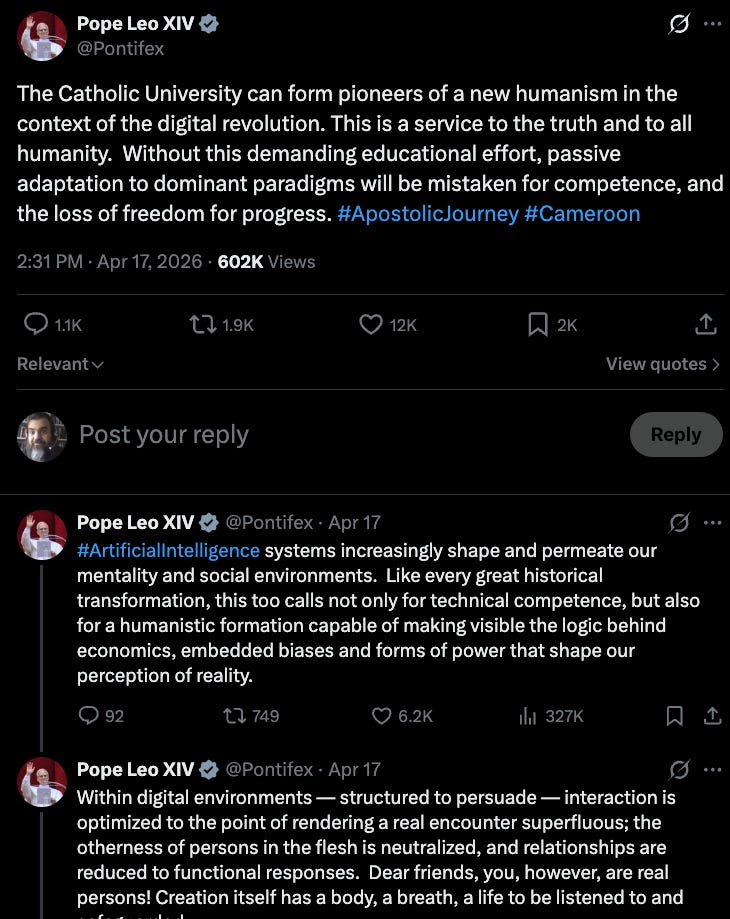
(NB: as I prepared to launch this report, the pope launched a major statement on AI, the encyclical Magnifica Humanitas. I’ll address that in a later post.)
We should consider how different nations apprehend AI. I was fascinated by a Pew study from late 2025, which showed quite a range of different views:

Note the American position as the world’s most anti-AI nation. The data confirms Schroff’s pithy remark. The reverse is true of Israel, by far the most supportive. The Anglosphere tends to be more critical than the rest, but there are interesting divides within continents, although Asia generally tends to be more optimistic about the tech.
Pew also sliced their data by age, finding younger people are often less likely to be worried about AI than their seniors:
In most countries polled, adults ages 50 and older are more likely than those ages 18 to 34 to say they are mainly concerned about the growing use of AI in daily life… In the U.S., the age gap is relatively small but still significant.
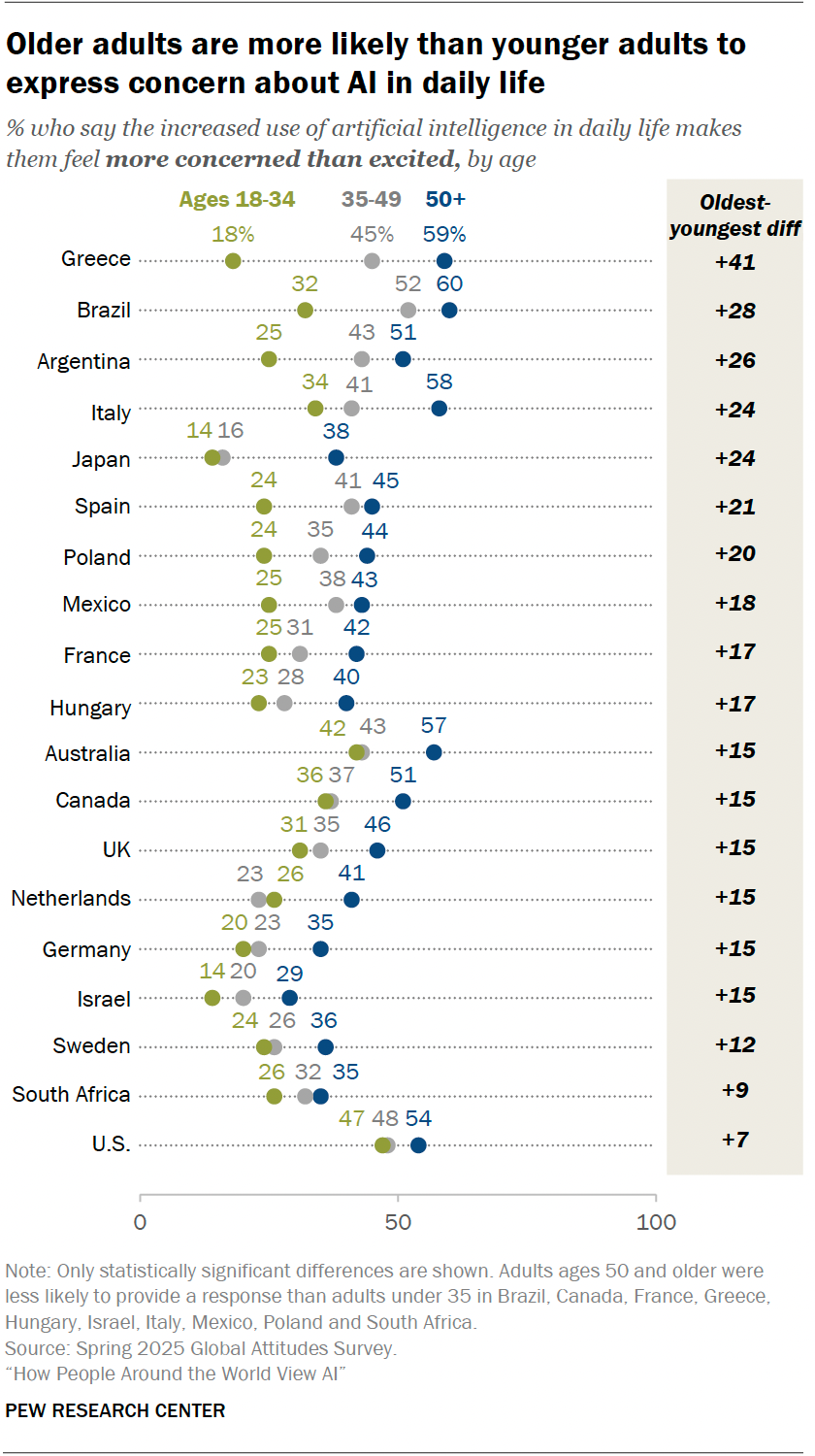
Once again, the US is an outlier in these global AI attitudes.
I was also struck by Pew’s findings around gender and education:
In some countries, women are more likely than men to be mostly concerned about the increased use of AI in daily life. In the United Kingdom, for instance, about half of women (47%) are more concerned than excited, compared with about a third of men (32%)…
In about half of the countries polled, people with less education are more likely than those with more education to be mainly concerned about AI in daily life. (In several of these places, people with less education were less likely to provide a response.)
Let’s look more closely at Americans. A Gallup study polled Gen Zers and found, overall, rising anxiety, anger, and skepticism, while at the same time discovering widespread expectation that respondents would have to use the tech. About half of GenZ reported using AI at least weekly.
A Quinnipiac University poll found even more about American AI habits and ideas. For example, selected uses in descending order:
Researching topics they are curious about: 51 percent say yes, up from 37 percent in April 2025;
Writing something for them: 28 percent say yes;
School or work projects: 27 percent say yes, while 24 percent said yes in April 2025;
Analyzing data: 27 percent say yes, up from 17 percent in April 2025;
Creating images: 24 percent say yes; up from 16 percent in April 2025;
Medical advice: 20 percent say yes;
Personal advice: 15 percent say yes;
Companionship: 5 percent say yes.
QU found evidence of an AI divide through several lines of questioning:
Just over one-third of Americans (35 percent) are either very excited (6 percent) or somewhat excited (29 percent) about AI, while 62 percent are either not so excited (29 percent) or not excited at all (33 percent).
Eighty percent are either very concerned (38 percent) or somewhat concerned (42 percent) about AI, while 18 percent are either not so concerned (10 percent) or not concerned at all (8 percent)…
Fifty-five percent of Americans think AI will do more harm than good in their day-to-day lives, while 34 percent think AI will do more good than harm,
Then there’s a divide skewing more towards a negative view when it comes to work. When asked how “advancements in AI are likely to affect the number of job opportunities for people,” the balance fell strongly on one side, albeit with interesting age differences:
Gen Z (1997 - 2008): decrease (81 percent), increase (4 percent), and not make much of a difference (12 percent);
Millennials (1981 - 1996): decrease (71 percent), increase (6 percent), and not make much of a difference (20 percent);
Gen X (1965 - 1980): decrease (67 percent), increase (7 percent), and not make much of a difference (20 percent);
Baby Boomers (1946 - 1964): decrease (66 percent), increase (10 percent), and not make much of a difference (20 percent);
Silent Generation (1928 - 1945): decrease (57 percent), increase (13 percent), and not make much of a difference (20 percent).
A recent NBC poll found similar results, yet with some interesting twists. Again the split: “A majority of registered voters, 57%, said they believe the risks of AI outweigh its benefits, compared with 34% who said the opposite.” This time, an interesting partisan divide, or lack thereof, appeared:
Asked which party is better at handling AI, 20% of voters in the NBC News poll said Republicans, while 19% said Democrats. Meanwhile, 33% of voters said neither party was good at dealing with AI, while 24% said the parties were about the same…
[There is] an even split of Republicans holding positive or negative views of AI (33% for each), while independent voters and Democrats held more negative opinions. For independents, 26% held positive views, compared with 48% who viewed AI negatively. For Democrats, the division is 20% to 56%.
We also see those age and gender differences, which can map onto political party affiliation:
The demographic groups with the most negative views of AI are voters ages 18-34, among whom the net favorability rating for AI is minus 44, and women ages 18-49, who reported a net AI favorability rating of minus 41.
Again, bear in mind my skepticism about these polls, as people have incentives to over- and understate their experience. Yet it’s interesting that search leads the way - which either describes Google’s AI mode having an impact, or justifies their decision to deploy it. (Wikipedia reports an 8% drop in inbound web traffic0
The rapid and massive data center buildout increasingly elicits local outrage. I’ve seen this in my community (Manassas, Virginia), where data centers have appeared with astonishing pace and impact. Many folks are furious. Our state legislator told me she hears more complaints about data centers than any other topic.
You can see examples of this attitude across the country. Here’s TIME magazine’s cover story on it:

Or, as seen in this cartoon:
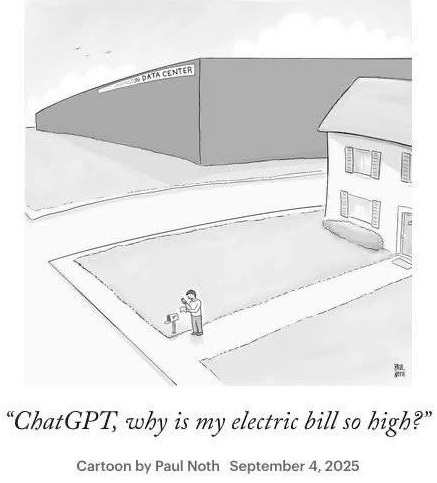
Note that the data center opposition is actually organized. People are holding meetings, staging protests, lobbying government officials. This is a demotic, grass roots movement as of this writing, but a few political leaders have been issuing statements, like Bernie Sanders:
You can find other signs of anti-AI activity. Some graduating students have booed commencement speakers for referring to AI in positive or neutral ways. The huge Comic-Con recently changed its policies on AI-generated art, from allowing to forbidding it. A University of Fairbanks student took a more direct approach to AI-generated art by eating a classmates’ exhibit about a relationship with a bot. An independent game developer removed his game from Steam because he had a change of heart of using AI to create its assets.
Local opposition has successfully blocked some data centers, according to a Wall Street Journal report:
Local opposition blocked or delayed at least 48 projects valued at some $156 billion last year, according to Data Center Watch, an organization tracking the trend. A record of 20 were canceled in the first quarter of the year because of local backlash, figures from climate-media outlet and data provider Heatmap show. Dozens more are currently facing similar obstacles on top of obstructions because of permitting snafus and equipment shortages.
Since this is America, there have also been a handful of violent acts. Perhaps the most visible was a man firebombing OpenAI CEO Sam Altman’s house, then attempting the same at the company’s main office. Lila Schroff reports that “someone shot 13 rounds at an Indianapolis councilman’s house and left a note under his doormat: ‘NO DATA CENTERS,’ it read.”
What might we take away from these stories, these developments and examples?
The companionbot side of AI looks durable so far. It doesn’t seem to be a majority use so far, but a good number of folks treat AI in that anthropomorphic way. Note the rise of physical robots in this sense. I expect to see more as the robot industry burgeons, including a range of AI-backed robots for companionship, retail service, security, sex, therapy, war, etc.
Producing content with AI continues to develop. Art, games, movies and more demonstrate technology-mediated human creativity. Schrader’s vision suggests an acceleration of AI use in art and stories. I’m intrigued by the presence of surrealism and fantasy in AI-created works, but am not sure how far that will go in the near future. Opposition to the use of that tech in art and story is increasingly vigorous, now entailing a careful scrutiny for AI in projects which don’t proclaim it. Once again, I wonder if we’ll see more public declarations of how much AI is in a given artifact. Will a Good Housekeeping-style third party emerge, registering items as 100% human, or 1/2 AI? How far will checking for AI in someone else’s work go?
Thinking about the pro- and anti-AI split, I expect to see it continue and perhaps extend, at least in the United States. As I’ve said before, I’m expecting more Democrats to oppose AI, while Republicans maintain their support for it, and AI becomes another partisan, culture wars front or signifier. Perhaps we’ll see the grass roots nature of opposition become a kind of AI populism. Or maybe refusing AI will appear as cognitive sovereignty, “The ability to maintain independent thought and agency in environments saturated with AI‑generated outputs.”
I also wonder about some kind of synthesis between the two AI attitudes. The Quinnipiac study offered one glimpse of this through a medical hypothetical:
Americans were asked if it were proven that an AI tool is more accurate than a human in reading medical scans, would they prefer to rely solely on information provided by AI, solely on information provided by a human, or a combination of both AI and a human.
An overwhelming majority (81 percent) say they would prefer to rely on a combination of both AI and a human, 14 percent say they would prefer to rely solely on information provided by a human, and 3 percent say they would prefer to rely solely on information provided by AI. [emphases added]
Now, AI is not exactly at that level yet, but the tech seems to be closing in. I’m reminded of “centaur chess,” or what Kasparov named “advanced chess,” whereby two humans play against each other while each uses AI. A synthesis including the best of both worlds?
On a personal note, I’m fascinating by the double role American culture plays in AI, being the world leader in developing the tech and opposing it, as per Lila Shroff’s aphorism. In my work I try to balance a focus on America for multiple reasons (a vital country on the world stage, a leading and rich post-secondary sector) with a global perspective. It’s a tricky balance to strike, given the intense parochialism within the United States, accentuated by some political tendencies. I hope to redouble my international work.
And thus ends this run of the scanner. Over to to you now, dear reader. Are you seeing any of these cultural responses to generative AI in your world? Are there other examples we should know of?
(credits: first image was Deborah Lupton’s ”Pop AI Collage”, Licenced by CC-BY 4.0; thanks to Ruben Puentedura, Jesse Walker)
Quick note to clarify that Hell Grind was shown in Cannes by a third party while the Cannes Film Festival was taking place. https://futurism.com/artificial-intelligence/cannes-not-showing-ai-generated-movie