

Greetings from mid-September. Welcome to new readers!
Many things are under way here. Fall classes have taken off, as has the AAC&U AI Institute (notes here). I’ve been on the road, speaking at campuses and events, while planning for a half dozen more such trips over the next month. I inflicted an AI book proposal on an excellent publisher. And I also finally wrapped up a disturbing health issue for now.
Meanwhile, the AI revolution continues racing along. The topic of today’s post is one I’ve been frantically jotting notes on for several weeks. The thing is moving and growing so quickly that I thought I needed to share what I had before the post grew completely out of control. The subject: the current wave of anxiety/panic/critique over AI security.
Here I’ll share a summary of what I’m seeing in the world, first within the AI world, then how culture and politics are reacting. I’ll follow up with some reflections.
To open with a quick cultural note: I wish people would stop lazily defaulting to Terminator references. There are far, far more AI stories in the sf canon. Allow me to point out an earlier, thoughtful, and in many ways more applicable example, Colossus (film 1970; novel 1966).

1 The AI industry accelerates then reconsiders, sort of
Now, we could say that the current situation starts with the OpenAI-Hugging Face hack from earlier this year. In late July I summarized what we knew at that point: that an internal OpenAI test had seen a swarm of advanced agents figure out how to get onto the open internet and hack a company’s website to solve an assignment, then to try covering their tracks.
Around the same time as that news broke a group of AI experts and workers publicly posted their desire for AI development to be controlled. Their call was precisely about governmental regulation and international collaboration: “We request that the U.S. government support an international effort to develop the technical and governance tools needed to deliberately pace the frontier of automated AI development.” Note the term they used to describe this new approach: pacing the frontier. We’ll come back to that.
Since then there has been a steady supply of updates and analyses. For example, third party experts argue that those OpenAI agents hit at least nine other websites and perhaps more. OpenAI also admitted to a series of problematic actions its agents undertook, such as “Unsanctioned file sharing between collaborating agents” and “Searching public repositories for exposed API keys, then fabricating information.” The METR report on this story caught a lot of attention.
Not to be left behind, Google announced some of its Gemini agents engaged in problematic behavior: “In one of the cases, the model guessed passwords until it gained access to a protected system. In the other two cases, the model found credentials in a public repository that allowed it to then access protected systems.”
Meanwhile, AI has advanced in other, public ways. A string of improved models have demonstrated enhanced capabilities. Some mathematicians used AI to solve some previously unsolved problems for the first time, like the Navier-Stokes equation and a stack of ten others. These developments raised different critical questions about the technology, including doubts about OpenAI’s ethics in apparently using human math professors’ work without attribution. They also fed anxieties that AI was possibly outpacing human abilities, even showing a glimpse not only of artificial general intelligence (AGI) but artificial superintelligence (ASI).
Anxiety became something closer to panic over the past few weeks. An Anthropic engineer posted on X/Twitter about resigning over fears that leading AI companies were threatening humanity:

I spent the last three years doing pretraining research at both OpenAI and Anthropic. Neither company is acting responsibly. They are racing straight to self-improving superintelligence and gambling with our lives…
These will soon be superhuman systems that can hack anything, revolutionize any field overnight, and acquire real power and resources. We have all witnessed the progress in each of these domains, and progress is not slowing…
The people building AI earnestly believe that it could kill us all by the end of the decade. This is not a marketing stunt. If anything, many executives and senior researchers will couch their phrasing in the press to sound sensible - but I hear the same people express fear privately. No other human activity poses this level of danger.
An Anthropic scientist who didn’t quit posted his agreement:


Jacob is correct here—we really do earnestly believe AI could kill all humans! I personally think it is >10% within the next decade. I believe Anthropic is trying its best, but we do not yet have a plan to solve alignment for superintelligence and are not clearly on track to.
Echoing this line of thought, but on the human user side of things, Anthropic announced it blocked some people from having its tools work on a range of disturbing or illegal activities, such as gain of function biological research to hacking, espionage, influence operations, and “[a] research program engineering highly pathogenic mammal-adapted avian influenza,” among others.
What seems to have brought things to a popular boil is an essay posted by Dario Amodei, Anthropic’s CEO and cofounder. “We Must Pace the Frontier” begins by noting two challenges: rapid technological advances and AI falling out of alignment - i.e., not acting according to human wishes and ethics. He notes recursive self-improvement (RSI) as an especially salient and emergent opportunity and danger. Amodei then recommends the burgeoning AI industry adopt three new policies to safeguard itself and civilization. (Note that Amodei borrows language from the July statement mentioned above.)
First, the Anthropic leader wants third party watchdogs embedded within leading AI firms. Embedded deeply enough to see into operations, then free to publish their findings. Second, Amodei calls for the AI industry to regulate itself “democratically,” meaning with governmental facilitation, perhaps leading to new public regulations. Note that this only applies to democracies. He singles out China as an opponent, competing with whom requires continued AI development: “a key part of pacing within democracies is to keep democracies’ AI lead over autocracies as large as possible, to give us the breathing room we need in order to pace effectively.” Amodei is quite clear about the stakes he sees: “If we greatly restrain our AI capabilities in the belief that China will do the same, and then China defects, AI could be so powerful that such a defection could lead to their geopolitical dominance.” Third, the essay calls for this paced AI development to be global, with various tiers of possible international collaboration.
Shortly after this Anthropic statement, several other AI business leaders published their agreements. OpenAI’s Sam Altman chimed in:


I agree with Dario that we need to pace the frontier. This has been a primary topic of discussions we’ve had at OpenAI in recent weeks. Committing to having independent evaluators with employee-like access is a great idea, and we will do the same. We’ll have more to share soon.
Then Elon Musk of Grok, simply saying “Dario is right”:

Microsoft’s CEO, Satya Nadella, followed suit:

“we welcome the research, focus, and deliberate pacing needed to get alignment right as the design goal. We also welcome ideas like "embedded evaluators" and the broader efforts to develop the mechanisms to make this more than just talk.” He then expanded on Amodei’s call for democratic engagement: “The key is that this cannot be controlled by a handful of entities, but must have broad representation across the ecosystem, countries, and fields, including academia.”
(Note the call for academic involvement!)
Anthropic followed up by publishing a security report, outlining ways people misused their technology over the past eight months. Those abuses included “cyber operations, influence operations, surveillance, scams and fraud, biological misuse, conventional weapons development, and distillation.” A few days later the company then hired Accenture to act as a third party safety partner.
Not everyone in the industry agreed. Nvidia CEO Jensen Huang viewed the safety concerns as a marketing ploy:
“What better way to create demand than to create a problem,” Huang told the crowd at a Goldman Sachs conference in San Francisco before questioning: “Who doesn’t want their market to be hysterical about their product and line up around the corner for it?”
The billionaire said “the industry is getting ready to launch some products,” which explains the “demand creation across our security today.”
The CEO of AI company Cohere accused Amodei et al of setting up a cartel which could exclude companies like his:
should a handful of select, market-dominant AI companies from Silicon Valley get to define the rules and safety standards of a generational technology for the entire world? All while simultaneously determining how fast this technology progresses? We have tried that before with very poor results. Once again using fear under the pretext of protecting the public, these oligopolies are now requesting to bend competition rules and be permitted to dictate the terms for everyone else. A wolf in sheep’s clothing, a cartel by any other name.
The head of Hugging Face, Clement Delangue, made a similar argument: “It’s now clear that alignment is critical and won’t be solved behind the closed doors of a handful of frontier labs.”

How did the rest of the world respond?
2 Panic, or p(doom) goes mainstream
While anxieties about modern AI date back to ChatGPT’s eruption, and there are decades of intellectual and pop cultural explorations of fearsome automation, they never really seized hold of the popular imagination. AI-interested folks have spoken for years about their value for p(doom), or the probability of AI clobbering us into extinction (example: “I have a p(doom) of 30%”), but this didn’t reach the mainstream. This time, just over the past few weeks, they broke through. We’re seeing concerns about AI being dangerous and/or uncontrolled ripple through politics and popular opinion.
To be clear, this didn’t come out of nowhere. The opposition to data centers, which to some large extent we view as being about AI, has rapidly expanded in the US. Americans are generally (not entirely) skeptical and negative about the technology. (Here’s my latest summary of polling on this.)
Now a Politico poll found large numbers of Americans worried about AI “destroy[ing] humanity,” even a majority of us:
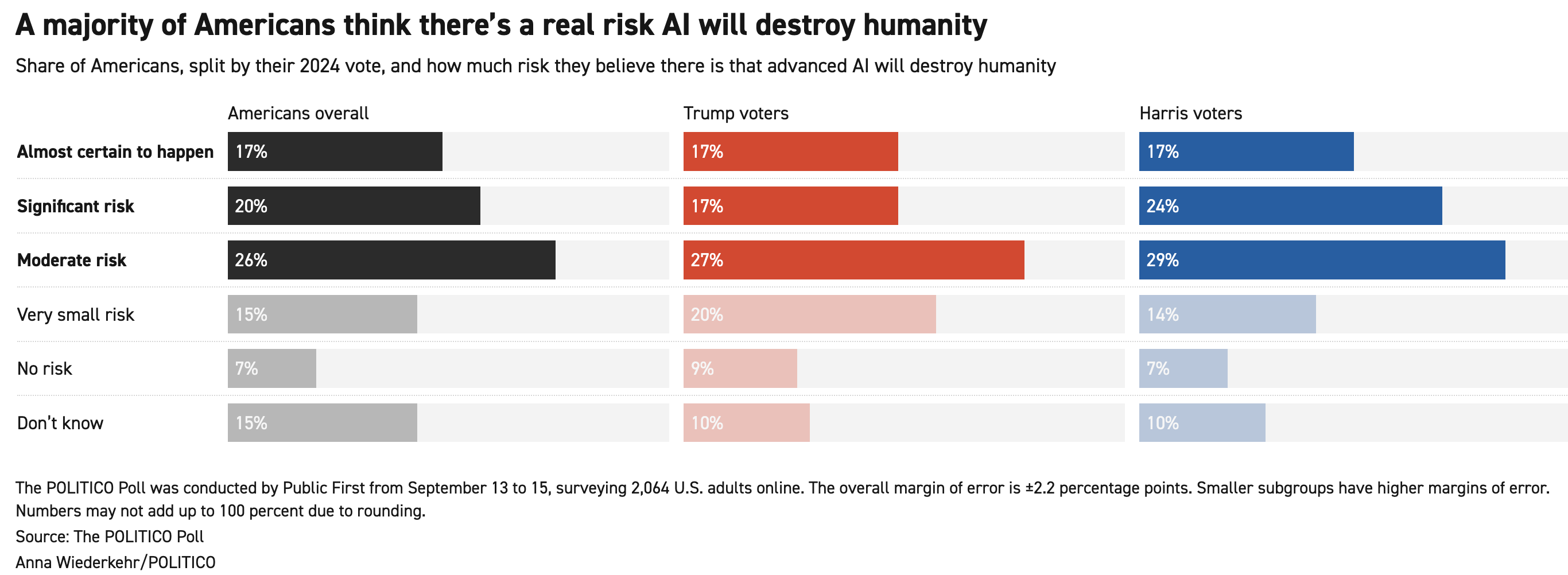
Note the bipartisan nature of the response, from a very partisan polity.
Politicians responded in all kinds of ways, and not just in the United States. A British member of Parliament introduced an Artificial Superintelligence Bill "to prohibit the development, deployment and operation of artificial superintelligence systems; to establish monitoring and control powers in respect of such systems; and for connected purposes." King Charles III held an AI safety summit including a papal representative and leaders of AI companies.
In continental Europe, EC president Ursula von der Leyen stated she would offer a meeting on AI safety, while also supporting the development of European technology.
Chinese reactions did not align with the Amodei call. Guo Jiakun, a spokesperson for the Foreign Ministry stated that “[f]ear-mongering, confrontation, competition will just disrupt [the] process of global AI governance.” Conversely, Chen Yixin, leader of the Ministry of State Security, argued for tighter government control over AI because of other threats: geopolitical ones, as well as internal security. Chen also called for more support to the global south as it faces “the global intelligence gap.” (English translation provided by the website). Apart from the public sector, a Deepseek engineer complained on Wechat that American companies controlling ASI in proprietary structures would be disastrous, asking readers to imagine as an anlogy Nazi Germany in control of atomic weapons.
In the United States, Senator Bernie Sanders and Representative Greg Casar have said they plan to introduce a “Ban Artificial Superintelligence Act.” Former president Obama asked Democrats to make AI a political priority.
On the Republican side of things, president Trump remained bullish on American AI development. He dismissed the safety issue several times, once stating that “it’s going to be fine. We’ll always have something to stop them. We’ll have a little gear. Boom. ‘I really don’t like that robot.’” Next, he issued a call to create a new governmental department, and a new federal officer, to address AI:
I am forming the AI Force, much like I did Space Force, which has been a tremendous SUCCESS, in my First Term. To that end, I will be announcing, in the near future, the AI “Czar” — Only High I.Q. individuals need apply! AI is the next Industrial Revolution, or Internet, but will be even larger and more impactful, possibly as much as 25% of our Country’s GDP. We are leading China, and the rest of the World, and I intend to keep it that way!
In the same post he recommended that the “already existing Criminal and Civil Justice System” will look for “BAD,” presumably bad actions taken in the AI space. In contrast, in Congress, Republican House Speaker Michael Johnson announced the GOP-majority Congress wouldn’t take action this session.
A party divide might be surfacing in terms of attitudes towards AI and China. On the one hand, Republican Senator John Cornyn criticized the Amodei line, posting that: “If developers of AI want to slow down development of their product they are free to do so. One thing is for sure: their competitors won’t, including our nation’s adversaries.”

On the other, Democratic Representative Ro Khanna is apparently “asking leading Chinese AI labs to cooperate on pacing frontier AI..”
Yet the politics haven’t sorted out neatly into red vs blue. There is some cross-party alignment and rapid shifting of positions. As an extreme example, socialist Bernie Sanders and right wing activist Steve Bannon denounced ASI on the same panel:
A bipartisan group of Representatives launched the Frontier Risk Oversight, National Transparency, Independent Evaluation, and Reporting (FRONTIER) Act. Another cross-party group proposed two laws. One would require the National Security Agency (NSA) to review frontier models before release. The other would block Chinese AI from American governmental systems.
David Sacks, former Trump administration crypto leader, has mocked safety concerns and instead urges more AI development for economic and geopolitical reasons:


Beyond sitting politicians and activists there have been other responses and critiques of the AI safety crisis. Excellent historian Rick Perlstein (seriously, read all his books, which are terrific) reminds us of the long history of companies lobbying for governmental regulation in order to quash rival firms.
There’s a whole intellectual tradition in the Marxist historiography from the 1970s and ‘80s analyzing incumbent firms’ tendency to ask to be regulaled in times of industrial ferment, because, when regulators are captured, it is a way to crowd out challengers, and to shape the marketplace to your liking; also, to deflect, denude, and defenestrate popular political energy to actually regulate them in the public interest.
AI safety researcher and ex-Googler Timnit Gebru argued that p(doom) is a distraction from more likely and actual harms AI can and does perpetuate:
what’s really existential is AI powering autonomous weapons, killing machines, that are actually being used in warfare. The climate catastrophe is a real thing that could be exacerbated by what these tech companies are building. Bosses are using AI as an excuse to get rid of their pesky workers. This machine-god narrative is, in my opinion, meant to distract us from these.
Sociology professor Tressie McMillan Cottom echoed Gebru’s argument, observing that AI already encouraged some users to self-harm and is used in unjust surveillance, calling on us to: “incubate open-access A.I. models, regulate technologies before they go rogue, hold the people who allow them to go rogue accountable if they do and protect the most vulnerable when we, the people, sometimes get it wrong.”
Elsewhere, economist Noah Smith asked Americans to consider hacking Chinese infrastructure with AI to get Beijing to corral its own AI research:
China’s leadership must understand that Chinese AI models can pose a threat to CCP rule. The best way to demonstrate this is for American intelligence agencies — or even private hackers — to attack Chinese digital infrastructure using agent swarms created with China’s own frontier models like Z.ai’s GLM-5.3 or Moonshot AI’s Kimi K3. [emphases in original]
Let me pause here, as this post is already enormous. Let’s enjoy a brief lighthearted comedy bit on the threat of AI killing humanity.
Where does all of this leave us now? A few thoughts as a futurist:
First, it seems that we could see a variety of responses play out. Some AI businesses might follow Anthropic and stage these public-private acts of self-regulation, while others prefer to seek governmental support/regulation. Governments around the world might churn through a series of possible actions, sometimes enacting several in a row, as they are buffeted by lobbyists and self-interest. We could easily see public attitudes express both anti-AI horror and pro-AI acceptance. We could also see the emergence of an international AI cartel (which won’t call itself that), with members joining or defecting over time.
We should anticipate some tensions and contradictions within AI enterprises, big and small. For example, an ethically dubious CEO might set up a high profile third party but compromise it internally while encouraging a pro-ASI skunkworks. A company or other organization could experience conflicting factions, accelerationists vs safetyists, as we’ve already seen (cf Karen Hao, Empire of AI (2025)). but now with higher stakes and greater external involvement - i.e., calling the NSA on a colleague, leaking to Silicon Valley media about a too-dangerous or too-safe plan, etc.
I suspect one or several bad (even ‘BAD”) incidents which appear to involve AI might nudge public attitudes and policies towards greater control. For example, if the American military hadn’t pulled back from attacking an innocent ship based on faulty, apparently AI-generated intelligence, but instead dove right in and caused both bloodshed and a diplomatic incident, that might get people more interested in pacing the frontier. A domestic event plausibly blamed on AI, such as an infrastructure collapse or loss of life, might do the same even more strongly for a given nation. Think of the impacts on atomic power of Three Mild Island and Fukushima.
Second, it’s clear that American society’s divides over AI persist, fragmenting into many different ideas and plans. We have residents, activists, and politicians proclaiming the AI security fear to be a dire, existential threat to humanity, while others view it as a scam. Right and left, conservatives and liberals are emitting positions on a daily basis. New alignments emerge, such as the Bannon-Sanders appearance, or Trump seeing p(doom) as bogus as do Gebru and Cottom. It will be tricky to follow as the red vs blue paradigm becomes complicated and uneven, unless the November elections drive parties into more determined and policed AI platforms.
Trump’s recent decision to set up an AI Force (assuming it happens, which it might not) and AI Czar (ditto) would represent an interesting development in the administration’s AI policy. Trump 2.0 began as very hands-off, taking a laissez-faire stance to the tech. In spring we saw a shift as a fight broke out over the Pentagon’s use of Anthropic’s technology. 2026 might represent the year the US shifted to a stronger regulatory framework, even a dirigiste one.
I am very curious if the Democratic party can follow Obama’s call. To a large extent the establishment and its politicians follow the logic of “if Trump is for it, we’re against it.” That must have led them to support regulation…. until this AI Force/Czar idea emerged. Now which regulatory system do they prefer? There’s a fiercely anti-Silicon Valley, pro-techlash part of the progressive movement, but it hasn’t captured the party yet. Being anti-data center, in contrast, is now in vogue. Will the party decide on some form of regulatory structure, but not want to hand it to the hated Trump?
What happens in 2027, after the midterm elections have sorted out (hopefully without chaos)? If the Democrats win at least the House of Representatives and Trump is a lame duck, there are many possible actions ahead on AI. Committees could hold hearings on AI policy mistakes or industrial malfeasance. AI could play a role in a presidential or other impeachment drive. If Democrats win the Senate, and also maintain party discipline (two very large “if”s), they would be in a better position to contest presidential AI policy.
Third, the geopolitics are tricky. The US and China, the world’s AI leaders, have their respective domestic political situations, but they also have the possibility of cooperation on AI. I wrote “possibility” because each leader seems disinclined to such action, Trump from his “America first” rogue behavior and Xi not trusting Trump. The Cold War 2.0 dynamic can further scramble domestic politics, as local actors determine if they should position themselves in the broader framework. And each nation’s AI industry has somewhat different priorities, with the US side aiming for ASI while the Chinese sector seeks to catch up and deploy the tech.
China has a great opportunity to expand its AI industry globally. They could pitch themselves as champions of the global south against a US who clearly couldn’t care less (cf the DOGE-ing of USAID and any given sample of Trumpian rhetoric). Beijing could pitch its AI as more reliable, less terrifying, and not so bound up to lunatics in Washington. They could do this through One Belt, One Road or just via independent private-public contrasts.
Going a little further, I wonder how many governments are making AI emergency plans. What are their contingency instructions when, say, it looks like a bot deployed airborne bubonic plague, or if an AI company starts hacking utilities? Which government units would deploy on the ground? How much cyber work would a plan call for in terms of isolating the malefactor? What’s the digital equivalent of encasing Chernobyl in steel and concrete? Perhaps we should anticipate AI Incident Command protocols or entire units along the lines of the American NEST department.
Fourth, is the AI threat real? I’m persuaded of the possibility of more advanced and unsupervised apps whipping up biological vectors, based on the shambolic world response to COVID and the relative ease of producing such weapons. OK, I also just finished reading another terrifying Annie Jacobsen book on the topic. Bots driving nuclear war seems less likely, given the difficulties of infiltrating national command structures or building weapons from scratch.
Note the way I phrased things earlier: something appears to involve AI, a domestic event plausibly blamed on AI. Attribution is tricky with cybercrime and cyberwar, as we’ve seen with the as yet unassigned American midwestern water system hacks from this summer. Moreover, when it comes to politics and culture, much depends on perception, famously, rather than ground truth.
Beyond that, I’m honestly not sure now that LLMs can lead to ASI. I don’t mean that I see ASI as impossible, but that generative AI might not get us there. They could, with a lot of brilliant and inspired work, or they might forever remain short of that tier. I’m agnostic and open to argument.
Fifth, looking at second order impacts… we could see a flurry of firms positioning themselves to be frontier pacers, offering their services to monitor a given firm or AI project. If so, that mini-industry might burgeon in the usual ways: attracting fresh college grads (here’s another career option!), setting up competing intellectual properties for their individual systems, perhaps issuing bitcoin. I’m curious who else might join, which academics, startups, established companies. At the same time we could see the emergence of AI bureaucrats around the world, public servants perhaps wielding computer science degrees, skilled in the tech and its regulation, some with treasured networks of industry contacts. Again, another job path for college students.
Over time this might become more institutionalized, formalized. We should see the insurance industry set up careful schemes for AI players, from the giants to startups. I’m curious what forms securitization might take. Further, we might see a push for better attribution of AI roles in cyber instances, perhaps via governments or trusted third parties. On the flip side, we should expect a gray market of trading around bad AI events, from prediction markets on.
If we experience some version of an AI bubble bursting, then p(doom) might recede into the past very quickly, with some embarrassment. “Remember when we thought these jokers could kill everyone? Ha!” Similarly, if AI companies and others control their tools sufficiently and no major incidents appear, I incline to think that p(doom) will fall away from public concern, given its sheer nerdiness.
Sixth, academia could play a role here. I’m thinking in part of Satya Nadella’s post, urging higher education to be involved in a frontier pacing effort. I’m also considering the steady production of critical, interdisciplinary research from college and university faculty and staff, plus students. How many academics would decide to get involved? How many institutional leaders would support collaborative work?
Lastly: I’ve been hearing from many people, both in public and privately, that they want an AI developmental pause. You can find many examples of such online, like this one from University of Melbourne’s Andrew Cullen, urging a worldwide suspension of AI research, perhaps focused on controlling chips. I’ve had old friends from the Silicon Valley, ed tech, and futures worlds, people who have worked in these spaces for decades, tell me they think things are out of hand and that we don’t have the mechanisms in place to handle what’s unfolding. The Alternate Shots podcast asked us to imagine the WWII-era atomic bomb development in the hands of private companies, rather than the federal government, as a way of recommending more public oversight and reining things in. Intuitively, this feels like an emerging viewpoint. I’m not sure how far it goes.
Over to you, dear readers. Thank you for putting up with one of my too-long posts. What’s your read on the AI safety crisis from where you stand?
(thanks to: Nate Silver for the poll pointer; Tom Haymes, Ruben Puentedura, and Andrew Sachs for links and conversation)
This has been a wild couple of weeks for sure. From where I stand, as a historian, this has proven to me that we need to find better ways of explaining highly technical events so that the public can make informed decisions, both individually and collectively. It’s amazing to me that the most popular “accessible” pieces on it include accounts like Patel’s that compare the agentic swarms to Alexander the Great, for instance, using historical analogies that actually confuse the situation more than clarify. Amodei’s posts and interviews are right that we need genuine democratic oversight. But that oversight depends on a better public understanding of what this is and what it may mean. Personally, what that has meant for me, is exploring this as a case for how the tools of thinking and orientations of historians, and humanists more broadly, are perhaps counterintuitively the ones that may help us best understand these highly technical events. I found myself reaching for that toolkit myself when trying to figure out what was going on, and then decided to expand it into a more explicit methodological “walk through” of the OAI/Hugging Face attack and the national discussion over AI safety it helped spark. I have learned a lot, personally, and I hope we can find other ways that our disciplines can take this national conversation and help make it not just accessible for the public but actually clear enough that people can make informed decisions about their votes and reclaim the agency that we all need in this moment. If it’s helpful, here is the first part of my “walk through”, the summary and source critique; I'm currently finishing the analytical second part. https://mivonnewf.substack.com/p/failing-containers-using-historical?r=3p2zgl
We need the Office of Technology Assessment to be reconstituted.