

Bill Gates, Microsoft cofounder and gigantic philanthropist, has published a new essay about how humanity should respond to AI. I’d like to share a summary and some quick thoughts about “The turbulent AI era is here. The choices we make now are critical.”
Why is this worth discussing? I find it so because Gates is an extraordinarily influential person, based on his wealth, technological career, and especially global networks. His views might offer a useful reflection of what some very rich and powerful people are thinking, which is important for the rest of us as we try to see ways forward through the AI revolution.*
Today I’ll summarize the essay, then add some reflections.
The tl;dr version - Gates sketches out what worries and impresses him about AI, then asks for the creation of new global institutions to grapple with the tech.
At the start Gates offers a quick sketch of what he fears and likes about AI. None of it will surprise readers. He’s concerned about AI causing unemployment, damaging minds, and enabling people to create and use weapons. He hopes the technology can accelerate research, increase people’s ability to get services, and generally improve life. But these possibilities are inchoate and we are fumbling them: “I don’t see evidence that leaders, experts, and communities are confronting the challenges adequately. There is no plan to ease the entry into the AI era.”
After that intro, Gates gets to the business, the core part of which is a call for building out “a domestic and international framework for dealing with AI.” Lest you think this means setting up a few committees or tweaking existing regulations, the man has far higher ambitions. He views no current institutions as ready to deal with AI, “[s]o we’ll need to make new ones.” That should occur both at the national and international levels.
These would have to be structures which can govern, backed by real power. In a New York Times interview Gates mocked the idea of the AI industry self-regulating, or taking voluntary guidelines seriously. “Self-regulation on the most dangerous tool ever invented? No, thanks!”
Gates emphasizes the scale he has in mind: “It’s hard to overstate what an enormous undertaking this will be.” He compares the present moment to how the United States erected a global and national apparatus to fight the War on Terror after 9-11, then sets that aside as too puny, because:
AI will require much, much more. It will affect national security as well as employment, education, taxation, energy, elections, air and water, public health, the financial system, law enforcement, transportation, public lands, and IT systems… At the national level, countries will need bodies that can set priorities across government agencies.
For example, at the global level,
an international organization will need to be built in parallel [to national ones].
It will be unlike any other institution we have ever created, though it can follow the model of some existing systems. There’s an inspections regime for nuclear weapons, regulations for international aviation, and agreements that protect the ozone layer. A new global organization for AI will need elements of all three and more.
Gates then asks for two more things. First, he recommends we designate certain jobs as off limits to automation, calling them “Human Reserved.” These would be ones people do best, mostly inter-personal work. They’d vary over time and space. And to be fair, Gates says he has unanswered questions in mind on this point:
The idea of Human Reserved raises a host of questions I don’t have answers to. Who gets to decide what we reserve for humans? What criteria should we use? How do you keep companies from cheating and using robots anyway? What happens to international trade when one country lets robots make something and another country doesn’t? These will need to be worked out in public as part of the transition plan. [emphases in original]
This reminds me of Joseph Aoun’s 2018 book Robot-Proof, which calls for organizing higher ed along the lines of what humans do better than machines.
Second, Gates wants a “robot tax” - specifically, a tax on robotic hardware and AI software (tokens). This would help replace income tax lost due to AI-driven job reductions and would go to paying for insurance and retraining. It could also “slow the rush away from human labor a little,” giving more time for civilization to adjust.
He also adds thoughts on AI and education. He begins by outlining some ways the technology can vitiate learning. Used wrongly, it “could … lead to many people learning less” as well as reducing critical thinking. On the other hand, Gates sees positive uses:
AI can be a boon for education as well, despite the concerns I mentioned earlier. It can free teachers up to spend more time working with students one on one or in small groups and give them a clearer view of where the whole class is struggling. For students, an AI tool that preserves what researchers call “productive struggle”—the cognitive work that builds understanding—can strengthen learning. When a student first encounters a new idea, the AI gives substantive explanations and offers both questions and answers. Later, when it’s checking their comprehension, it holds the answer back and helps them arrive at it on their own.
Gates concludes by describing his unfolding actions:
I will use my voice and time to get AI and equity higher on the public agenda. I will raise the issue with lawmakers every time I visit Washington, D.C., and when I meet with leaders around the world. It will be front and center in my conversations with the people who are developing AI models. I will advocate for the national and international framework I described earlier. The Gates Foundation will help drive beneficial usage, including in Africa. Breakthrough Energy, a company I founded, will use AI to help companies develop cheap clean energy and help solve the climate problem. I will also be writing about AI on a regular basis…. [and] I will try to widen the circle of people shaping this debate.
If we take him at his word, he’s leading a one-person campaign for humanity to take AI seriously.
So what might we make of this statement?
The robot tax seems most likely to appear, based on what I’m seeing in the world. It’s a straightforward policy solution which should win support from a population anxious about AI and loathing data centers. It would satisfy those worried about economic costs of job displacement. And for governments worried about deficits, it’s a time-tested response.
The idea of classifying some jobs as “Human Reserved” makes an intuitive sense. Think of how often you’ve seen people express frustration at being forced to talk with a bot and blocked from human interaction, or experienced that feeling yourself. Think, too, of potential job losses; this kind of protectionism will surely appeal to labor constituencies. A big challenge to such designation is the rapid expansion of AI, followed by robotics, across various spheres of human activity. As I keep saying, much depends on how people perceive AI’s use. (Although the term “Human Reserved” sounds clunky to my ears.)
I am more concerned about the push to create new national and global institutions to handle the AI revolution. Again, Gates didn’t ask for current entities to act differently or to reform themselves to face nots, but for the creation and implementation of novel structures. That’s a bold idea, even literally revolutionary in some situations. Historically, it reminds me of how different nations created new institutions to handle nuclear weapons and power. Further back, it reminds me of railroad commissions and other bodies. I honestly can’t tell if humanity is ready to take such a step for AI. Anti-establishment animus is running high, for one; adding to established institutions seems risky.
The geopolitics are also tricky. Gates didn’t mention president Trump, and that figure represents a major challenge to any such effort to build international organizations, not to mention national ones. Perhaps we can envision other nations creating entities to bypass American AI policymaking. I also noticed that Gates doesn’t mention the United Nations, so I don’t know what role that leading international body might play in his aspirations.
Gates does explicitly call for US-China cooperation, albeit without details. Such would surely be crucial to a planetary AI engagement, given the two countries’ stature in general, and in particular with AI. Yet that relationship is fraught at present. Beyond the two great powers, how might the rest of the world participate? How do we get, say, northern Europe alongside subSaharan Africa and Peru plus North Korea in a meaningful, effective process? Is this where the UN comes in, or should we build something like the COP meetings on climate change? (Here’s one column from an Indian perspective)
Now, all of this might be besides the point. Gates could wage an energetic, media-savvy one-person campaign which nobody else joins. The effort might fritter away his vast fortune to no effect. It wouldn’t be the first time a rich person launched a personal project to no avail. Yet this call for action on AI might resonate with people in government, business, and civil society, and so it’s worth reflecting upon.
One last note: should humanity embark on such a heightened rethink and response to AI, academia can play a key role. Gates’ essay invites us by name to participate. Here I think colleges and universities have much to contribute: our teaching, our researching, and our public scholarship and service. As I’ve been telling audiences, the academy brings enormous and essential knowledge and skills to bear, which the world needs as it wades through the AI revolution.
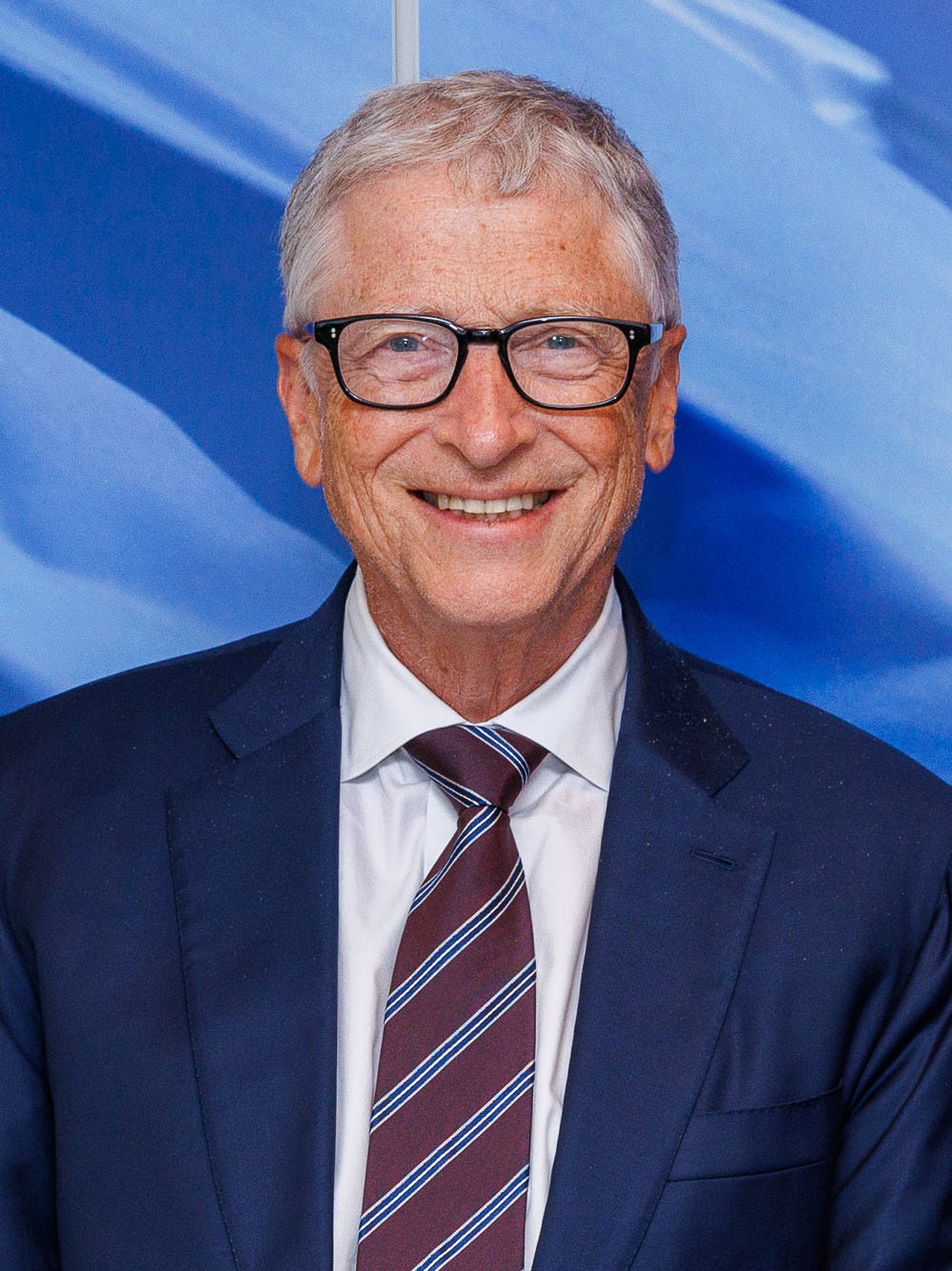
(Gates photo by © European Union, 2026, CC BY 4.0, https://commons.wikimedia.org/w/index.php?curid=187056847)
*Because some may criticize: first, I’m not a Microsoft fan, nor are there many in the world. I actually wrote this on two Mac machines (laptop, Mini) and an Android phone. Second, I don’t intend to uncritically carry forward the musings of billionaires as a fan or stenographer. Instead I see Gates as a very influential person and his thoughts therefore worth considering and criticizing.
A terrific summary and discussion of Bill Gates ‘views, and I’m grateful for you bringing it to our attention.
Who gets to decide? That’s what I want to know. Throw away anything Trump; in two years he will be out of our hair. I don’t trust globalists dictating to nations in the best interest of individuals—no thanks. Gates needs to use his vast wealth and influence in to empower, not further subjugate people. Build libraries and staff them. Construct
museums and concert halls around the world(name them after yourself e.g. Carnegie). Dig wells and solar power plants in arid regions and train locals to maintain and operate them. Fund private hospitals in places that need medical care.
Bill Gates may be influential, but he is still one person with singular opinions. If we have learned anything in the last decade, it’s that one person with power is dangerous, not beneficent.