

Double, double, toil and trouble;
Fire, burn; and cauldron, bubble. (Macbeth Act IV scene 1.)
Greetings from the Halloween season, dear readers. Here in the mid-Atlantic United States we are deep in autumn, with leaves and temperatures descending and the dark advancing. Summer has truly passed and winter looms, such as it is here. The mood is dramatic, which makes a fine setting for today’s topic: the latest economic developments in artificial intelligence.
There is a *lot* going on, and this issue feels like it could be endless, especially given the torrents of commentary and analysis out there. On revision, Substack tells me I’ve already broken the “too long for email” barrier. So I’m going to hit some highlights, hopefully spark some comments, and start working on the next posts.
(If you’re new to this newsletter, welcome! This is one of my scan reports, which are examples of what futurists call horizon scanning, research into the present which looks for signals of potential futures. We can use those signals to develop trend analysis, which we can then use to create glimpses of what might come next. On this Substack I scan various domains where I see AI having an impact. I focus on technology, of course, but also scan culture, government and politics, economics, and education, this newsletter’s ultimate focus.
It’s not all scanning here at AI and Academia! I also write other kinds of issues; check the archive for examples.)
Now, on with the scan. We’ll look at actual uses of AI in the workplace, touch on emerging business models and practices, then dive into the bubble question, followed by a look at workforce issues. We’ll conclude with some futures reflections.

Actual uses of AI in the workplace
How people actually use AI is a topic I’m fascinated by. It’s not easy to determine, as many studies rely on self-reporting, which can be dubious. It’s also a field of great scope (hundreds of millions, soon more than a billion users) and complexity (so many programs, applications, and possibilities!). So let’s see what we can best learn now.
A new paper by Microsoft researchers identified leading AI uses, based on Copilot data from 2024. There’s quite a lot in the document, so I’ll pull out the parts which struck me. One top-level finding was that no job was 100% replaceable by Copilot, at least in 2024. Another viewed the technology as a conversational partner, rather than as an information retrieval service: “In terms of AI performing actions, we show that it often does so in a supporting role to the human acting as a coach, trainer, or advisor.” (cf this post)
A third result concerned specific kinds of jobs and their use of AI:
we find the major occupation categories with the highest AI applicability scores are Sales; Computer and Mathematical; Office and Administrative Support; Community and Social Service; Arts, Design, Entertainment, Sports, and Media; Business and Financial Operations; and Educational Instruction and Library.
The authors broke professional functions down to general tasks:

I notice information-gathering is the leading user purpose, but not what the team thought Copilot was doing. Instead, leading AI actions were communicative.
Next, the researchers decomposed functions still further:

Again that divergence between information-gathering and communication.
In another use case, American financial giant JP Morgan Chase continued its drive to include AI in daily operations. The current focus seems to be equipping staff with AI assistants, especially agents, which can speed up task performance. At a smaller scale, Nextdoor will deploy AI as a recommendation engine for local services and Dow Jones added a third AI-powered translated content service (French, after Korean and Japanese). Delta Airlines is rolling out an AI tool to personalize fares for individual customers (archived copy).
There were also cases of companies using AI badly. Consulting firm Deloitte generated a report for the Australian government, which turned out to have used AI poorly, throwing up errors which a human expert would have caught. Let Brent Anders explain:
AI business models evolve
The AI industry continues to try new business models, as do companies using AI. Perhaps the biggest story in this area is OpenAI which once again shifted its unusual corporate structure. Now there is a nonprofit organization, the OpenAI Foundation, which owns part of the for-profit OpenAI Group PBC (public benefit corporation). The official line is for the business engine to power the non-profit public good. On a sarcastic note, I do enjoy Matt Levine’s line about how OpenAI’s CEO wants to ask AI for business ideas: “It really is the greatest business plan in the history of capitalism: ‘We will create God and then ask it for money.’” This is especially sharp in the wake of news that the firm lost $12 billion last quarter.
OpenAI also set up a marketplace function, allowing users to buy stuff through the platform, especially agentically. Retail behemoth Walmart partnered with them, so that users can use AI to buy their products.
Content licensing stories continue to appear, as when Perplexity licensed Getty Museum materials. Gannet licensed USA Today content to Perplexity as well.
Another story appeared which we might consider an anti-model. Reddit announced it would block the Internet Archive from archiving its contents, as the former feared AI companies were scraping material from the latter.
Investment boom or bubble?
Are we in an AI bubble? I’ve tracked this question for years, collecting data, issuing forecasts and scenarios (most recently), and advising audiences to pay careful attention to possible ways the boom might fall apart. Ever since my last post bubble talk has continued to loom large. A series of major players raised the idea, including Jeff Bezos, who offered the idea that we’re in an industrial bubble, where some companies fail but the overall sector keeps growing and providing value. Starting in August Sam Altman started speaking of bubbles, overvaluation, and losses to come. (Here’s the most passionate and extensive argument for a bubble about to pop.)
Money keeps thundering into AI as speculation grows at a blistering pace. Startups keep receiving funding, even in the billions (for example) (another example) (perhaps notoriously). Anthropic raised more investments on a value of $180 billion. The market now values OpenAI at $500 billion. Nvidia’s value just broke $5 trillion. Microsoft, often derided in the technology press, saw its value crack $4 trillion based in part on its AI work. Other AI businesses are seeing prices balloon:

Players are taking on more and more debt now. Hundreds of billions of dollars are pouring through the sector now, especially to keep building out data centers and their requisite infrastructure. One sign of this is that we spend nearly as much on those centers as on building offices, and seem likely to exceed that number soon:

For another small (!) example, Anthropic made a deal to spend billions on chips from Google. In other words, if the bubble is inflating to astonishing heights, it shows few signs of popping as of this writing. Obviously things could burst.
Yet the scale of AI’s financial footprint and the sheer amount of money it’s drawing in from the rest of the economy is causing worries beyond the sector itself. Analysts are furiously trying to figure out just how much of the American economy is AI, and how much of the nation’s growth depends on the nascent industry. One popular estimate notes that seven AI-heavy tech firms now account for one third of the entire American stock market’s value. More: “Harvard economist Jason Furman recently said that AI investments accounted for nearly 92% of U.S. GDP growth in the first half of 2025.” In those same months “AI-related capital expenditures contributed 1.1% to GDP growth, outpacing the U.S. consumer as an engine of expansion,” according to JP Morgan. More starkly,
Ruchir Sharma, chair of Rockefeller International, told Fortune that in a way, “America has become one big bet on AI,” and warned that “AI better deliver for the U.S., or its economy and markets will lose the one leg they are now standing on.” [emphasis added]
There are several cases where the money is running in the other direction. LLM prices have been falling on a per unit basis, especially due to the excellent work in open source AI:

Ernie Tedeschi (Budget Lab at Yale University) offers some caution. Yes, AI spending is contributing to GDP growth, but a chunk of that is imported, so not part of the American economy in a key sense. There are also strong lags in data, sometimes lasting years.
Yet problems are emerging. Some of the major AI spending takes place within the sector itself, as companies buy from or trade with each other. Chipmakers, cloud companies, and AI firms are very close with each other:
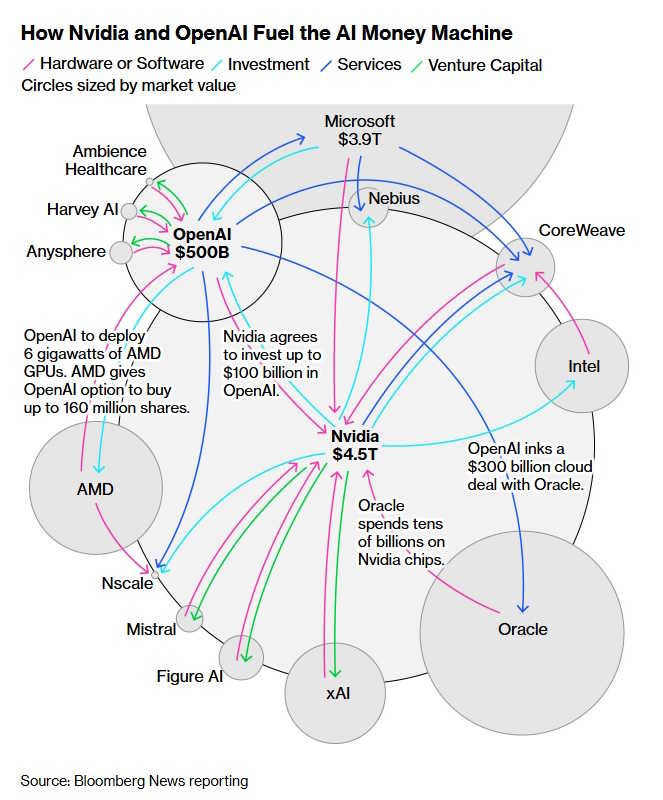
And now it looks like Amazon and Google each own a chunk of Anthropic. You could call it a financial ouroboros, each creature in the AI bestiary ultimately gnawing on the others’ tails.
Meanwhile, some consumer utility bills are now rising, driven to some degree by datacenter build outs, that driven to some degree by the AI boom.
Let me end this section with two cautions. First, economist Noah Smith isn’t as disturbed by the snail-biting as others. He sees the practice as likely a mix of business diversification and prudent financing. Second, this Neutron post suggests a bear market is likely in the immediate term (so, a bad market correction, a bubble bursting) followed by continued growth, a bit like my Jagged Infrastructure scenario. Overall, I am worried that demand for AI, both paid and unpaid use, will fall short of very, very, very expensive supply.
AI and the world of work
How AI will impact labor is still an open question with signals and developments pointing in different directions.
At the most ambitious level, Walmart’s CEO stated that AI would impact every job in his vast company, and not just there: “Maybe there’s a job in the world that AI won’t change, but I haven’t thought of it.” He mention position cuts as well as creating new ones.
What kinds of jobs will be changed, ended, or created anew? Recent weeks have seen hiring freezes and cuts to numerous white collar professions. That Wall Street Journal article cites thousands of layoffs to corporate staff at Amazon, Booz Allen Hamilton, General Motors, Molson Coors, Rivian Automotive, Target, and United Parcel Service. Amazon is leaning into both AI and robotics to reduce and redefine its workforce. A Washington Post report notes cuts and hiring slowdowns at Goldman Sachs, JPMorgan, and Nestlé. A Goldman analyst described a hiring drop in the technology sector, especially for young workers. CNBC reports that YouTube offered buyouts to some workers. One job facing automation might be the very venture capitalists who fund AI. A new research project trained LLMs to pick startup winner and performed, apparently, at a comparable standard to human peers.
There are countervailing signs. An Australian bank laid off four dozen staff, then rehired them when AI underperformed internally. I keep hearing reports of companies struggling to integrate AI into operations, having to expend more staff time to address issues with output quality and workflow redesign.
Reflections
Overall it feels like 2025 is something of an inflection point for AI and the economy, a moment of furious work in the midst of deep uncertainty, or risk. We’re building out a huge ecosystem in great uncertainty with vast sums of money swarming through multiple nations and it’s not clear if we’re headed for a railroad future of a rich, globally used infrastructure or a technological misfire, a 8-track for the 21st century.
Companies are changing work and laying off staff, but tentatively, to a degree indicating it’s still early days. I can imagine firms using the fear of AI to keep down compensation and quash unionization drives.
Some business models are continuing, like content licensing and expanding on-platform marketplaces.
The use cases are very interesting. There’s a split between enhancing human work and replacing it, which has been a long-running theme. There’s also a split between users turning to AI to get information versus those having conversations with the bots, which for me reflects our tension between information retrieval and AI content generation. Licensing and its opposite continue to chug along.
That’s all for now. The scanner turns its attention to other domains.
(thanks to Todd Bryant and Hernan Carvallo for fine links)
The promised efficiency gains... these have a way of not materializing the way companies project. There are real improvements, no doubt. But at the corporate level, the infrastructure seems expressly built for "replace workers, expect more from fewer employees." This may be the result regardless of the cost.
The actual innovation is probably happening with people creatively using the tools. That's been true for every technological leap.
That split between information retrieval vs. conversation use cases sort of supports this. Users are finding their own applications.
Is the capital expenditure justified by what people are actually doing with these tools?
Win's the AI Net this Week. At a minimum, your most fun post to date, Bryan. Making this daily full time AI dev old-timer a wee tad giddy :)
Day dreaming in far off CBD open office ... so, ummm, a technocratic admin future where 'stay at home' office workers is the first step to 'you're no longer needed' office staff cause Data Centers!
A free and easy future for People everywhere getting digital food, housing and sex credits merely being Meta Glasses-Wearing Data Bots happily keeping our virtual #DataGod alive and omniscient. And Spy vs Spy Entertainment non-stop to boot!