

Somehow three years have passed here!
In late May 2023 I set up this newsletter, establishing its format, learning the interface. Here’s what I promised to do: “This Substack explores possible futures for AI and the academia, based on research and foresight analysis.” A few weeks later, after a lot of behind the scenes work, I expanded the plan:
What might artificial intelligence mean for higher education?
Answering that question is the job of this newsletter. Here I’ll explore the many intersections, impacts, effects, and relationships between emerging AI and the world of academia.
It was a way for me to organize my AI work in one place. It was a gamble that anyone would read or support the thing.
Today I’ll look back on how this newsletter has actually done since. First I’ll summarize some of the leading ideas I’ve been tracking, then take you behind the scenes to show how I make this Substack work. Then I’ll conclude with some future-oriented thoughts.
tl;dr version - I think I fulfilled the original mission and explored a lot of stuff as well, with the help of a growing, thoughtful, and kind audience.
1 How AI and the world have developed since 2023
Three years is a long time in the digital world, especially in the hard-charging AI field. On the technology side, we’ve seen LLMs continue to develop in terms of quality, quantity, memory, media outputs and inputs (code, images, video, audio, social networks, 3d, gaming, XR), and hardware housing. AI plays a major role in search, both within Google’s crucial search engine as well as inside of individual AI platforms. More AI projects are using AI to develop AI, approaching a self-improving loop state. OpenAI and Anthropic have ballooned in size while Google seems to be leading the pack. Open source projects race along, sometimes backed by corporate players. Agents have taken off unevenly, with all kinds of projects and standards in play. Artificial general intelligence and superintelligence loom ahead to some degree, although their definitions are breaking down.
Also looming ahead are various economic catastrophes and revolutions. AI critics have proclaimed an imminent bubble bursting since this newsletter began, but the industry has only grown expansively in terms of total investment. Projections out technology-driven unemployment have only been born out fitfully, mostly in coding jobs. AI infuses the white collar workforce, but sometimes fails and increasingly generates pushback. No AI firm has turned a profit yet, although multiple experiments are under way (advertising) and Anthropic may cross that frontier this year by selling coding to businesses with a side of security. Companies are partnering with each other and with others through collaborative projects, mutual purchasing, and licensing content. Some observe a divide opening up between Chinese and American AI businesses, with the former driving AI into daily use while the latter plugs away at AGI and ASI.
Speaking of which, the political dimensions of AI have been fermenting and bubbling for the past three years. We’ve seen arguments about which war was/is the first AI one, be it Russia’s Ukraine invasion, Israel’s war with Gaza, or the US-Israeli attack on Iran. Multiple political actors have used AI to generate political content, from images to video. National, super-national, and local governments have tried out various forms of AI regulation to various levels of success. Back to China and America: some argue that AI is one battlefront in this new cold war. Some new principles have started to appear on the global stage, like AI sovereignty.
In the United States the politics around AI are approaching a traditional partisan framework, but haven’t quite settled there. The conservative Republican party has been very supportive of the technology, overall, and adopts a mix of laissez faire with targeted industrial support. Progressives on the Democratic side have tended to oppose AI, but have not yet won the party over. Data centers have increasingly elicited ground-level opposition. I don’t know if we’ll see an AI centrism appear or if the tech will become a culture war flashpoint.
One political dimension concerns the intersection of climate change and AI. On the one side some argue that the technology will improve humanity’s ability to understand, mitigate, and adapt to global warming as it parses vast amounts of data and generates new analyses. On the other are those seeing the technology - especially data centers - racking up vast electrical bills and soaking up precious water. Data on this is all over the place, difficult to work through due to secrecy, standards issues, and untangling AI from the rest of cloud computing uses. (I have a post on this in the pipeline.)
I’ve also tracked AI in culture and found people both using and abhorring the technology for artistic and storytelling purposes. The tools continue to get more powerful and accessible, generally, and AI output spreads across multiple media. Opponents like the term “slop” to describe the latter. AI as companions has been spreading as well, although it’s hard to get good data on this. Culture also serves as a ground for debates over AI, especially in the United States.
In these contexts, higher education has been grappling with AI in multiple ways and in many different forms. Overall, the majority of institutions have no strategic AI policy, instead deferring decisions to divisions and departments, which means decisions actually devolve down to individual faculty members. In the classroom (physical and virtual) we’ve seen people (students, faculty, staff) use AI to make stuff, as conversational partners, as simulation runners, and as objects of study, while some faculty have objected to some or all of these roles. AI functionality appears in different forms of educational technology. Assessment remains a shambles now, with no good solutions at scale. AI appears in the curriculum to some extent as some faculty teach about the tech across the curriculum (i.e., computer science, writing, media studies, economics, etc.). Some argue for a general education form of AI literacy, while others seek to determine individual fields’ particular use (or not) of AI. Scholarly research and publishing are also using AI for analysis, content co-creation, discovery, and review. Experiments occur across the board, from academics developing open source projects to archives adding AI as a new interface to their materials. Opposition to AI across the academy is very clear, from some faculty unions to individual faculty members, scholarship and teaching to public statements.
Overall… the AI field is very much in flux now. After doing this work my sense is that we face a set of possible futures to various degrees of enormity, from a white collar rust belt to major improvements in health care, a neofeudal dystopia presided over by AI oligarchs to a wave of new AI-integrating jobs. Higher education is struggling here, already beset by numerous other forces (cf my most recent book), in some key ways unsure as how to proceed. Three years of this and things are still fluid, despite changes of inevitability. Academics and humanity as a whole are still working out this revolution. We retain to a large if uneven degree an amount of agency which we can exercise, should we choose to do so.
2 Making this newsletter
Three years of this newsletter: behind the scenes, I work on this Substack daily. My process looks like this. I scan for news and developments across the AI cosmos. That means consulting email newsletters, social media, an RSS reader, scholarly articles and books, and traditional news sources. I also and frequently hear from people who want to share what they’ve discovered or seen; you can see them credited in this newsletter.
I do this work in conversation, meaning I steadily share what I find with other people and learn from them. Most days this takes place on social media and it’s interesting to see which platform reacts in different ways. I email a swarm of bright folks to see what they think about some stories. We host AI sessions on the Future Trends Forum. I also encourage AI conversations in the rest of my professional life. For the past two fall semesters and the upcoming one I’ve co-taught a class on AI and higher education at Georgetown University’s Learning, Design, and Technology master’s program. Over the past two years I’ve served as faculty in the AAC&U Institute on AI, Pedagogy, and the Curriculum, connecting teams from multiple colleges and universities. And for as long as this newsletter has been around I’ve given multiple in-person talks, virtual presentations, and panel appearances on AI and higher ed. At every step I’ve solicited feedback and tried to host conversations. The point is to make better spaces for discourse on the topic, while sharpening my own work along the way. All of this feeds into the Substack you’re reading now.
That Substack in turn depends materially on a gigantic Google Doc, broken down into major topics (tech, eduction, culture, politics, economics, climate, allied health, robotics), then into subdivisions under them, into which I paste links and add ideas just about every day. Once one piece has evolved enough I carry chunks of that over to Substack, where I have a series of posts in drafts. Each day I advance them depending on what I find and am thinking about. Overall, I aim to post a completed newsletter once per week.
So far, I haven’t quite hit that target. Let’s consider some numbers from the Substack backend. I’ve written 106 newsletters here, or around one issue every 10 days. I’ve posted about AI and the higher education, yes, but also added reports on what I think of as the contexts for that subject: society and politics, culture, economics, and current events.
A word about that topical expansion: one of the fine things about writing over time is seeing how one’s expressed interests develop. As we saw in the “Web 2.0” days serial writing gives us time and space to explore, then to build on those explorations. For me I find analyzing a topic like post-secondary education requires addressing adjacent fields which seem likely to have a meaningful role. Now it seems like those contexts outnumber my education posts and also the purely technological ones, which is interesting. That reflects my broader method of thinking of the future, a rough integration across multiple intellectual fields and aspects of human experience. (Here’s another example of this approach.)
One interesting direction this newsletter took was introducing the world to my wife Ceredwyn’s model of narrative programming. That first post sketched out the argument, that LLMs depend heavily on storytelling throughout their training sets. Users can do well by including narrative elements in prompts. We have more coming up in this vein.
Posts here have tended to be on the long side, a few thousand words each, often causing Substack to warn me about excessive word count. I’m still trying to write shorter ones as well.
Meanwhile, a growing number of people have been reading here, which delights me. Started from zero in summer 2023, there are now 5,054 of you fine people, according to the Substack stats. Growth has been steady over this period:
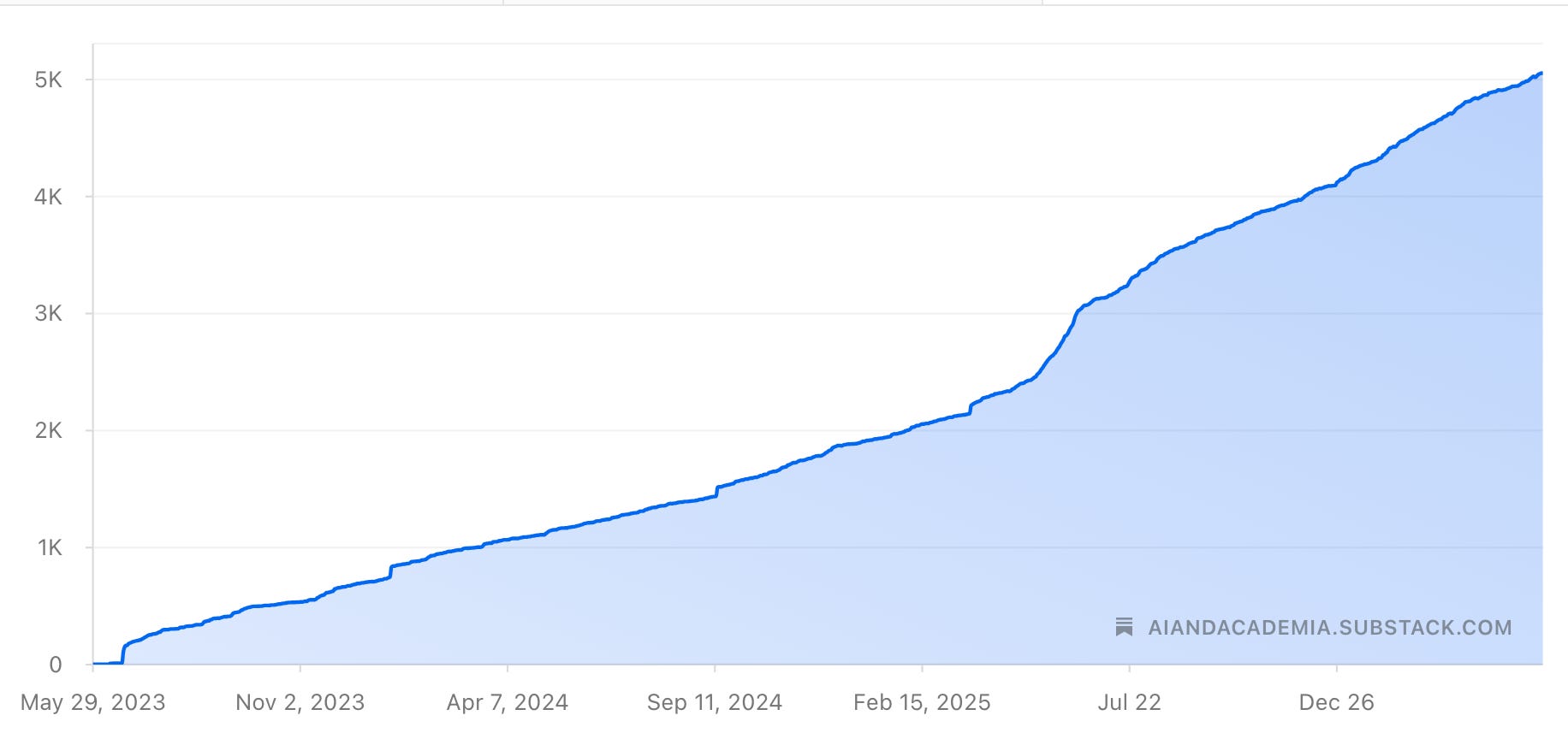
Why is this awesome? As a writer, I find being read is one of the best things in the world. And also those numbers translate into conversation, as some of you post thoughtful comments here, while others reach out to me via social media and email, sometimes sharing individual posts. That discussion adds to each post, making the whole thing richer and also improving my own thinking. (And if you’re new here, welcome!)
Among you all, 79 are now paid subscribers, which means two things. First, I must say thank you to each of you for this generous support! Second, doing this work requires a lot of time: daily research, writing, testing, interviewing, crafting, and so on. AI is crucial to academia’s future, I think, and I need to carve out even more hours to do this work. Put another way, time on this project is taken from time allocated to others as an opportunity cost. So your support literally makes this newsletter happen. Gradually “AI and Academia” is becoming a kind of self-sustainable lab. Accordingly, here’s one of the Substack buttons:
So far I’ve made all content here free. I haven’t put anything behind a paywall. That suits my pro-open mindset.
Two more process notes. I’ve been surprised by how little connections there have been between social media and this newsletter. I always make a point of announcing new issues across Bluesky, LinkedIn, X/Twitter, Mastodon, Instagram, and Facebook, but few readers come in through those portals. I know some of them (Facebook, Insta, X) make a point of hiding links, so I try tricks to go around them (links in comments, for example). Yet there’s very little in the way of active engagement on my posts on those platforms, even less conversation.
Substack’s own data shows a very on-platform pattern. Users clicking on this newsletter number in the hundreds, including from the mobile app. The only exception is Google searches, which are very high, demonstrating that the web version of this newsletter (as opposed to the issues appearing in your inbox) is prominent to some degree. In contrast, clicks from the socials only constitute around 1% each of inbounds.
On a different note, people sometimes ask me how I use AI to make this newsletter. I haven’t used it to generate any writing, as I prefer to do that myself. In my research I sometimes consult different AI to see what it comes up with - for example, Google Search’s AI mode, or what Claude offers. That often gives me a good, quick sense of the official narrative on a given topic.
I started this newsletter by using AI art for a few reasons, one being that my artistic skills are horrendously bad. I’d like to improve them, but have no time and am very far from making anything I’d show to folks. I do take photos and like to think I’m getting better at that, but their content rarely matches what this newsletter covers. I search Flickr for Creative Commons-licensed images, but also often strike out. AI image creators, in contrast, generate images I can use. It also seemed appropriate in a kind of dogfooding way to use the tech I was writing about.
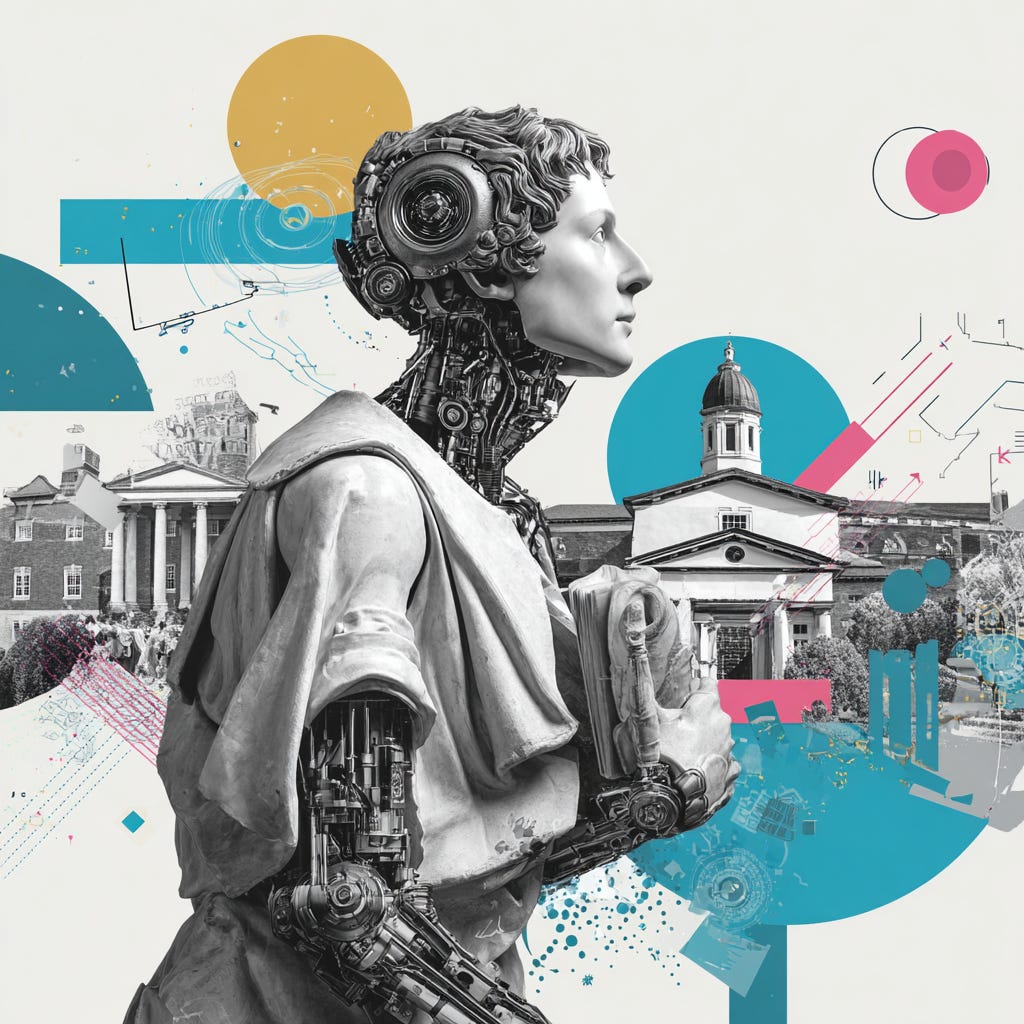
Yet I’ve gotten pushback for using AI images over the past two years, citing general anti-AI arguments as well as criticizing AI art for stealing income from human creators. Folks rarely have practical alternatives to offer, besides “use no images” (a nonstarter these days) or “just hire artists.” I’d like to do the latter and have done so in the past, but at the rate I would like to produce these newsletters artists payments becomes a major line item. Now, my old friend Alan Levine recommended using the Better Images of AI site, which I’ve taken to doing (cf the first one in this issue). The images are more abstract than I’d like but I appreciate the chance to at least give credit to human artists.
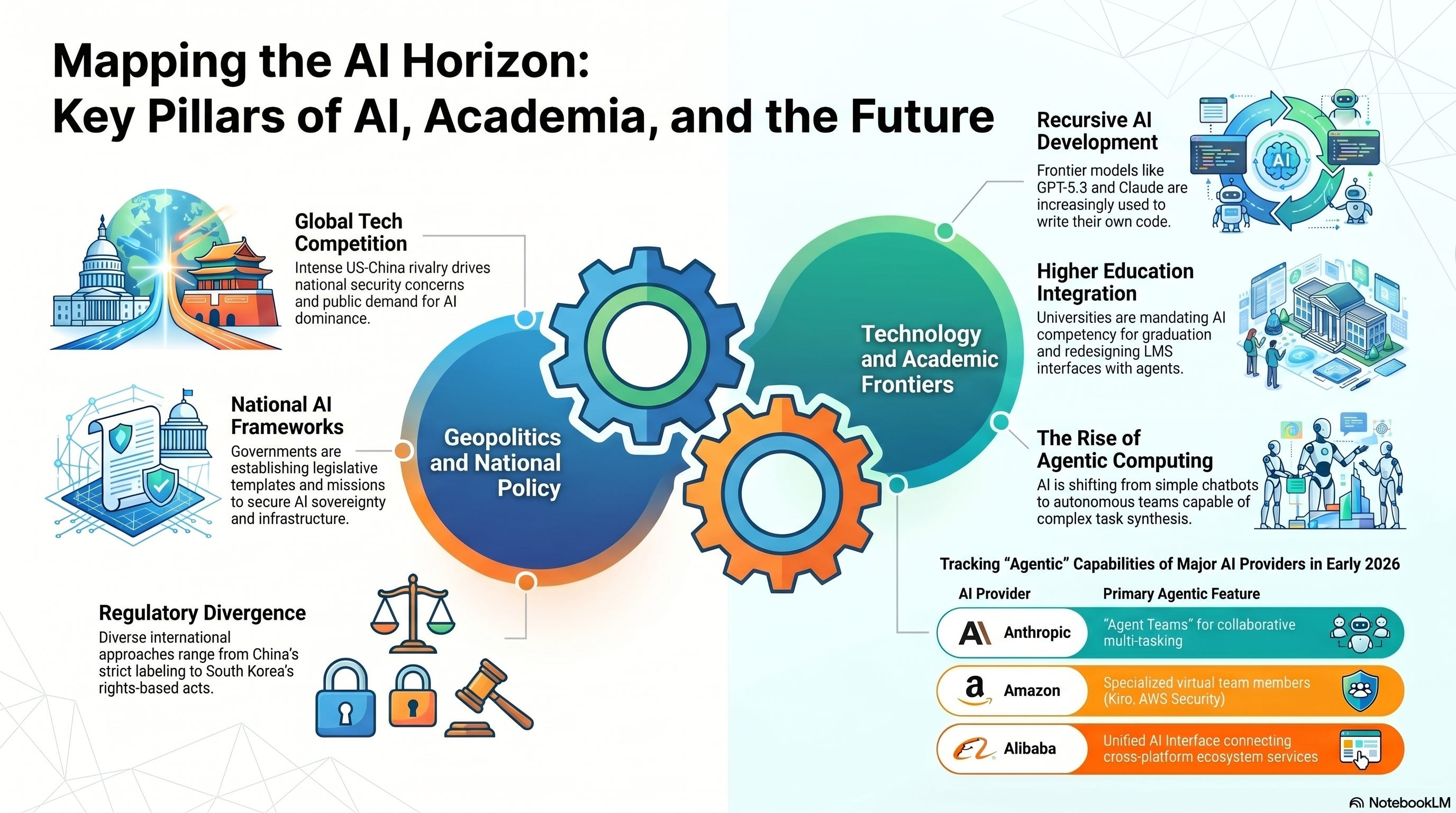
I’ve also been using NotebookLM in a basic way, feeding it this newsletter’s archive to see what it makes of it. It’s like having a reader on tap who reflects on the materials. It’s useful to see which themes it finds. Interestingly, NotebookLM thinks my environmental scan is the major purpose of this newsletter. Here’s an infographic it came up with along these lines:
3 Onward!
So what’s next for this newsletter?
I’m committed to not only continuing this Substack, but increasing the cadence of issues. Hopefully that means posting more relative short newsletters, although this one isn’t a good example of that desire.
If I can keep up that pace I can reach for more subtopics, like current events. Ceredwyn and I are working up more posts about narrative programming. I also want to offer more actual futures work, giving scenarios and other possibilities for where the we might take the AI revolution.
On a formal level, I am curious about Substack’s other features, which I haven’t really used yet. I’ve got recommendations for other Substackers, but haven’t thrown the switch yet. I’m especially interested in the platform’s audio and video features. Readers, any thoughts?
Beyond Substack’s technology, I would like to explore doing more AI work for this report, starting with using agents for research.
Earlier I said “AI and Academia” is becoming a kind of self-sustainable lab. I hope we can do this and experiment about what that might look like as an emergent 21st-century entity.
That’s all for now. We have come to the end of another too-long post. I’m grateful to all of you for reading, commenting, and supporting this newsletter. The comment box stands open for any thoughts or suggestions.
Onward!
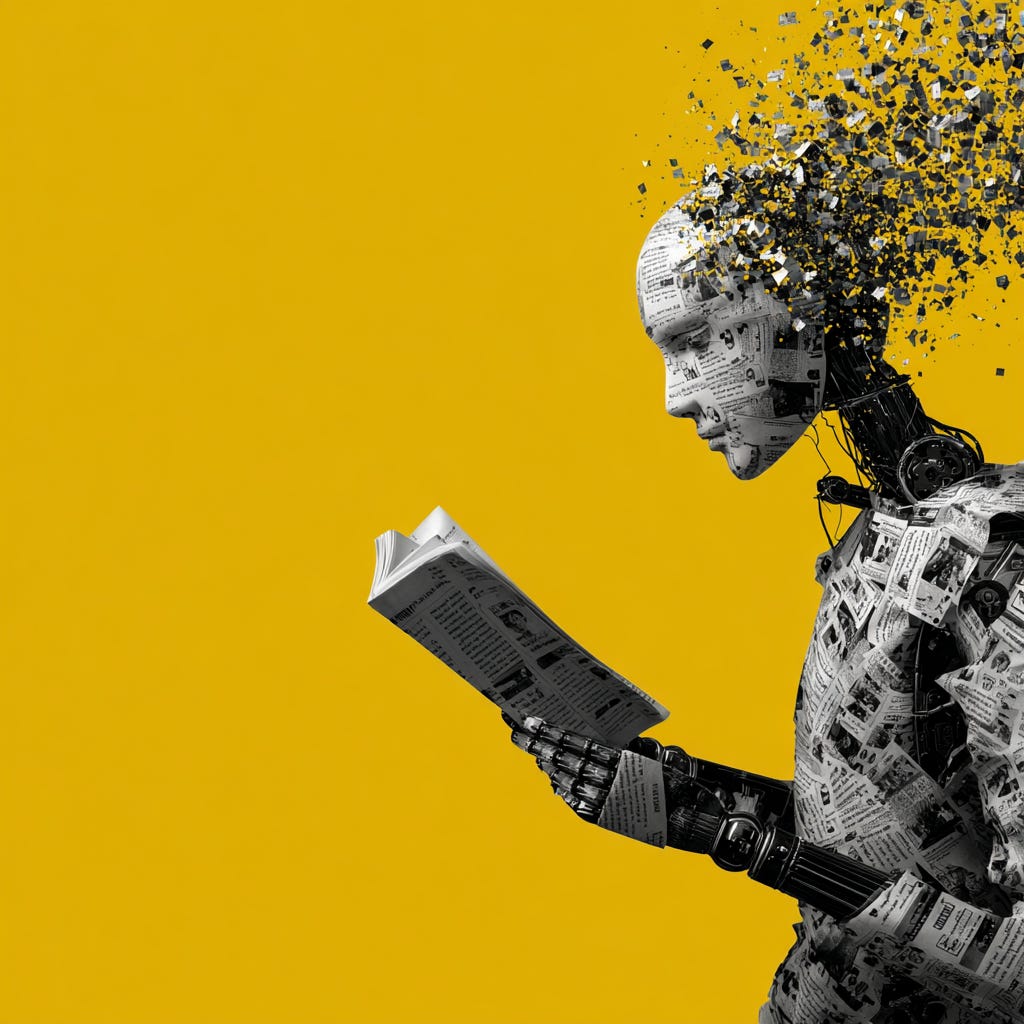
(opening image, “Digital Nomads Across Time,” by Yutong Liu & Digit / https://betterimagesofai.org / https://creativecommons.org/licenses/by/4.0/)
Thank you for this reflection and recap! As a side note: I appreciate the way you often link national and global political aspects to the analysis of AI in higher ed.
Congratulations, Bryan. Three years in, and the consistency and quality here continue to set a standard. When I was figuring out what my own Substack on technology innovation, AI, & ministry could look like, your "AI, academia, and the Future" was one of the first places I looked. It remains one of the Substack channels I most look forward to seeing posts from!