

Greetings from September as fall classes are settling in. I hope all readers on campuses, as well as those reading from other situations, are doing well.
Today’s another attempt at a shorter post. Before I fire off a series of scans and a reflection, I wanted to share two AI things I worked on this month. One is a presentation to the American Association of Colleges and Universities (AAC&U)’s latest AI Institute. The other is a new twist on my AI and higher education seminar for Georgetown University’s Learning, Design, and Technology (LDT) graduate program. I hope either or both or of use.
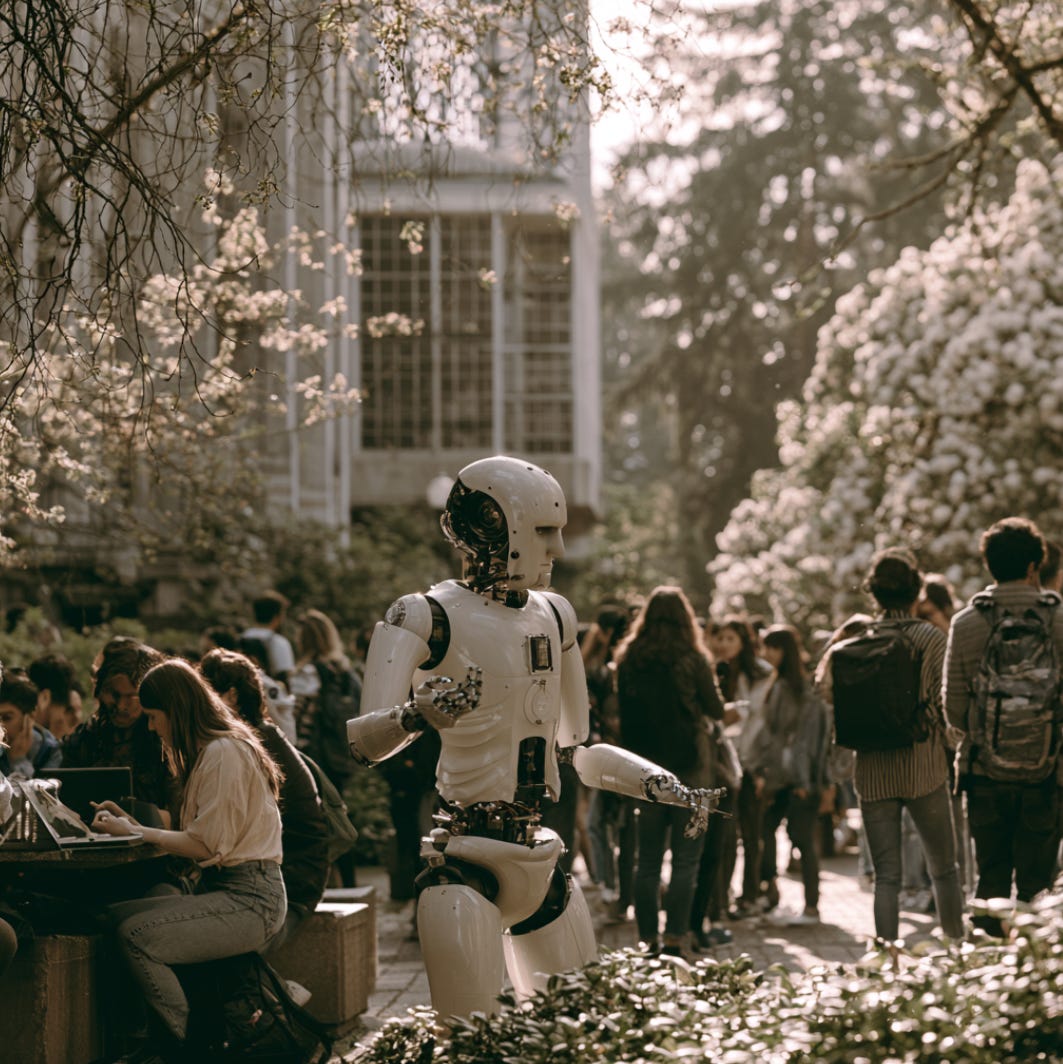
To begin with, the AAC&U AI Institute is an annual event, spanning an academic year. It’s virtual, consisting of two online conferences, a series of webinars, and many small group video meetings. Participants join in campus teams, committing to developing and presenting on their institutional AI work; this year there are nearly 150 teams. A two-day event in September opens the Institute, which ends with a similar online conference in April.
I’m one of the mentors, meaning I meet with and help three campus teams during the year. I also give presentations. Last year I presented on AI and climate change (yes, I owe you all a post on it). This time I spoke on “Preparing for the Post-AI Workforce.” Here’s the abstract:
How might colleges and universities best prepare students for the world of work during the AI revolution? This session begins by modeling different possible changes to the labor market, including at the macro level of aggregate employment, the possibility of technology-driven unemployment and underemployment, and transformed work functions. We continue by exploring possibilities for new jobs and disaggregated positions, based on current economic analysis. At the campus level we analyze different institutional responses, from undergraduate literacies to discipline-specific knowledge.
And here are the slides, fairly bare, mostly text, as a pdf:
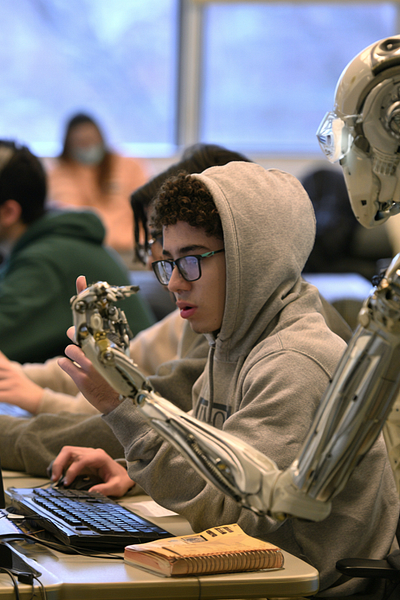
The tl;dr version - the labor market is getting strange under AI’s impact and might get downright bizarre. Higher ed has a lot of options for better preparing our students to enter the post-AI world of work.
I always hope for audience discussion when I present, and was happy that people were sharing thoughts throughout. Many campuses already do AI-related job preparation, albeit in fragmented ways, driven by individual units or departments, while some leaned into their career centers, general curriculum, or first year seminars. There was interest in how to support students in wildly different AI levels as well as to align a given discipline with its likely job placements.
By the talk’s second half I focused on the research angle. That is, I thought some academic disciplines (economics, business, political economy, sociology, computer science) could do fine work by researching how the labor world is changing. Internally, the rest of each campus would benefit from those findings. Externally, the world as a whole might appreciate what these academics reveal about this aspect of the AI revolution. (I’m increasingly keen on this last bit, which I think of as the academy teaching the world.)
Meanwhile, I started teaching my AI and higher education seminar. I’ve taught this previously (here’s the 2025 syllabus) but this time rebooted it as a challenge-based class. I had an elaborate plan, a vast and complex syllabus with many components, which I set aside for this more democratic, student driven, improvisational setup. I wanted to explore how challenge learning worked, but was also concerned that an elaborate plan launched in September would have holes in it by October and possibly collapse by December, based on how fluid and fast-moving the AI revolution is.
We’ve met once, and here’s how it worked. Beforehand, I emailed the class to describe the challenge system, then loaded up the LMS (Canvas) with resources, including potential readings, class exercises, and assessments. When we gathered, I got everyone (six students, one remote: small class) to introduce themselves by sharing their thoughts on AI, as did I. We did several rounds of this, rapidly surfacing concerns and topics. Next, I gave an introduction to LLM technology mixing presentation with discussion, level setting the class, making sure everyone had at least a baseline understanding of neural networks, deep learning, tokens, and so on.
With everything thinking and talking about AI, I turned the class to the topic of challenge planning for the class. I asked them to develop big ideas to explore through a Miro board, which we then turned into questions, which became challenges. We touched on how to prepare students (undergrad and grad) for the post-AI workplace, how to develop faculty, what becomes of digital literacy, and more.
Then I asked the class to identify one of those challenges to focus on for the next few weeks, when we could investigate the topic then built out something in response. This took some time, but we settled on one challenge. For the investigation component each student agreed to research scholarly and journalistic materials stemming from their professional interests, to write about them in the class LMS, then be prepared to discuss it all in our next meeting.
Overall it went differently than I expected. As an energetic instructor, I was planning that I’d have to hold myself back, but for much of class students were very interested in talking through the subject of AI. When it came to planning seminar actions, though, energy slowed and I had to nudge people forward. I was impressed by the range of AI topics students surfaced which easily covered a semester’s worth of work.
I’m very curious to see how students want to take the class forward, which topics surface, what exercises and assessments they come up with. I have a lot of options for them, but will probably impose a requirement that they scan current AI events and be ready to speak to them when we gather.
…and that’s it for this post. Two of my AI activities this month, for your consideration.
I hope everyone’s having a productive, thoughtful, and safe fall semester so far.
Thanks, Bryan, for sharing the class plan and the student uptake. I'm always surprised and delighted how students can take the lead in helping to shape a course, on the fly. I'm keen to hear how the AI class proceeds, (esp. since it's a grad course) given job market woes, inflation, and in today's news, the real and frightening potential of an AI apocolypse unless there are governmental regultions other than from AI leaders, at Anthropic etc. who are now calling for a brake and guardrails on their AI development.
Thanks for sharing. Almost makes me want to teach again (almost). Two points: 1) the effect AI has on entry level jobs is disputed, with one influential paper identifying remote work, not AI, as the primary culprit. The thinking is that new hires out of college cannot be trained as well in a remote environment; they need in-person mentoring. So some companies have been hiring fewer entry level positions where mentoring would be frustrated by distance. 2) we have already seen examples of AI completing research that passes peer review. It’s not a question of when. It’s already capable of work that gains the approval of human reviewers.
I wrote about AI’s impact on the job market here: https://www.jaxbusinesscalendar.com/articles/did-ai-kill-the-job-market
And I wrote about AI in publishing (along with the 3 options publishers have) here: https://jgellers.substack.com/p/academic-publishing-in-the-age-of